
To learn how to verify remote job offers, begin with the company’s official website. Find its careers page and contact HR through the site rather than using links in a recruiter’s message. A familiar company name or polished offer is not proof. Compare the sender’s email domain and hiring process with the company’s official information. Be cautious about pressure to act quickly, chat-only interviews, upfront payment requests, or demands for sensitive financial details before a written offer and secure onboarding.
Key Takeaways
- Protect your personal and financial information, and treat requests for upfront payments as a serious warning sign.
- Be cautious when a recruiter relies only on messaging apps or pressures you to respond quickly.
- Use the company’s official careers page and contact channels to verify that a role and recruiter are genuine.
- Assess the full hiring process for warning signs, including unusual interview practices and offers that seem too good to be true.
1. Personal information and money targeted by scammers
Remote job scammers target both your money and information that can enable identity theft. Reported U.S. job-scam losses reached $501 million in 2024, compared with $90 million in 2020. A typical remote-job-scam victim loses about $2,000. Treat requests for payment or sensitive account details as reasons to stop and verify the offer.
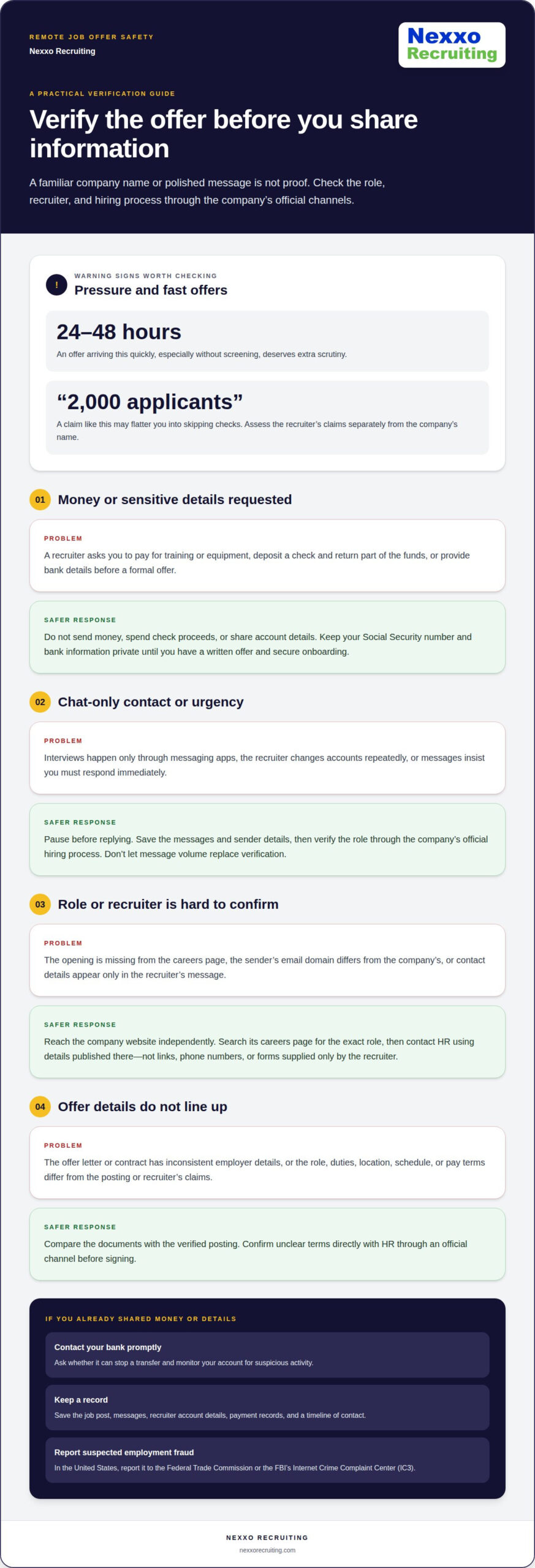
Never pay upfront for training, equipment, or an application. A scammer may ask you to deposit a check, use the funds to buy equipment, then send back part of the money. Don’t transfer money or spend the check’s proceeds. A check may appear to clear before the bank discovers a problem, leaving you responsible for funds you withdrew or transferred.
Keep your Social Security number and bank details private until you have a written offer and are completing secure onboarding. A recruiter requesting bank information before a formal offer is a warning sign. So is a request to pay in cryptocurrency to access work or receive wages. Stop using that channel and verify the role through the company’s official hiring process.
Distinguish routine application details from information that could expose your identity or finances. Share relevant work history during hiring, but don’t send account numbers, payment card details, or identity documents in response to an unsolicited message. Before entering sensitive information in a form, confirm that it is on the company’s official site and that you have received a formal offer.
If you have already sent money or shared bank details, contact your bank promptly. Ask whether it can stop a transfer and monitor the account for suspicious activity. If you suspect identity theft, consider placing a free fraud alert or credit freeze. Save messages, payment records, and the job posting; they can help you describe what happened when reporting the incident.
2. Scam communication channels and excessive contact
Some employment scammers conduct interviews only through messaging services such as Telegram, WhatsApp, or text. A chat-only process can make it harder to confirm who you’re speaking with or whether they represent the employer. Be cautious if a recruiter refuses other hiring steps, changes accounts repeatedly, or moves the conversation away from the company’s hiring site. Save the messages and sender details before blocking the account.
Fake-check and equipment-purchase scams use a supposed job transaction to route money toward a seller chosen by the scammer. The recruiter may present the purchase as a required hiring step, but a legitimate employer provides required training materials or equipment, or clearly deducts costs after you’re officially hired.
Repeated messages and demands for an immediate answer can also be pressure tactics. A recruiter may claim you’ll lose the opening unless you act right away. Don’t let message volume substitute for verification. Pause the conversation, save the messages, and assess the role through the company’s official hiring process.
In the United States, report suspected employment fraud to the Federal Trade Commission or file a report with the FBI’s Internet Crime Complaint Center, known as IC3. Keep the job post, recruiter’s account details, messages, and a timeline of contact. These records make it easier to describe the approach and show how the recruiter tried to move the conversation.
If you sent money or shared bank details, contact your bank about stopping the transfer or monitoring the account for fraud. Explain what information you shared and when, and keep a record of the bank’s response. Don’t continue negotiating with the recruiter while addressing the risk. Use verified channels for follow-up and include relevant messages in your report.
3. Verifying a company through its official site
Start at the company’s official website, reached independently rather than through an email link. Open its careers page and search for the exact role. Compare the title, duties, location, time zone, and working hours with the offer. Remote postings should clarify the role’s location and time zone, and whether hours are fixed or flexible. To learn how to verify remote job offers, compare the posting with the recruiter’s claims.
If you can’t find the opening on the careers page, contact HR using details published on the official site. Don’t use phone numbers, forms, or links supplied only by the recruiter. Ask HR whether the role and hiring contact are genuine, then wait for a response through an independently verified channel before proceeding.
Compare the recruiter’s email domain with the company’s official domain. Look for misspellings, extra words, or a different ending. Then contact HR through the company site and ask whether that person is handling the opening. A familiar company name in the sender display field doesn’t prove who sent the message.
Compare the offer letter and employment contract with the verified posting. Check that the employer name, role, duties, work location, schedule, and pay terms match what HR confirmed. Look for inconsistent company names or contact details. To understand how to verify remote job offers in practice, confirm unclear terms through official HR channels before signing.
Research the company’s online presence separately. Search its exact name and compare the business identity on its official site with the recruiter’s messages and documents. Look for consistent names, role descriptions, and contact details. Business reviews and profiles can provide context, but they don’t replace direct confirmation through the company website.
Save the job post, open the careers page independently, and contact HR through the site. Compare the recruiter’s email domain and offer documents with the company’s response. Together, these steps help establish whether the recruiter, employer, and specific opening are connected through an official hiring channel.
4. Fake recruiters and phony offers
Common remote job scams use impersonated recruiters, rushed offers, and work that doesn’t match a credible hiring process. An offer arriving within 24-48 hours, especially without screening, deserves scrutiny. A message claiming you beat 2,000 applicants may flatter you into skipping due diligence. Treat fast timing and unusually personal praise as pressure tactics, then assess the recruiter’s claims separately from the company’s name.
Compare the offer’s duties, hours, and pay with the role’s stated requirements. A listing promising $1,000 weekly for two hours of work each day is an unrealistic example. A salary of $80,000 for data entry may also be a warning sign if the duties and qualifications don’t support it. Pay alone doesn’t prove fraud, but an outsized promise paired with vague work calls for careful scrutiny.
Watch for offers that make you a middleman. A request to receive and reship packages may involve goods purchased with stolen cards, connecting you to suspicious activity. Some task pitches promise commissions for simple online actions, then demand cryptocurrency to clear a balance or release earnings. A promised payout does not prove that the work is legitimate.
Assess the hiring process, not just the recruiter’s profile. An offer without an interview can be a warning sign, particularly when the recruiter says the decision is urgent. Save the job post and messages, then compare the role with the company’s official careers information. Search the Better Business Bureau site and business reviews for reports of impersonation, treating individual reviews as context rather than proof.
Once you’ve ruled out suspicious pitches, focus your search on opportunities with clear role details. Nexxo Recruiting’s remote job listings can help you find openings to assess through the employer’s hiring process.
Nexxo Recruiting
Nexxo Recruiting helps you continue your search with remote job listings for entry-level candidates. Each listing includes job details and a direct application link, providing a clear starting point for assessing an opportunity.
Apply the verification steps above to every role you find: review the employer’s official careers page, confirm recruiter communications through company channels, and assess the offer before sharing sensitive information. Nexxo Recruiting lists opportunities in data entry, tech, digital marketing, virtual assistance, and customer support. These listings can help focus your search while you carry out your own checks.
If you’re ready to explore remote openings, contact Nexxo Recruiting.
Make verification part of your job search
Knowing how to verify remote job offers gives you a consistent way to assess opportunities as your search develops. Keep a private record of the roles you pursue, the hiring stages completed, and any questions still awaiting answers. Review it before responding to a new message, especially if the sender or requested next step differs from what you expected. A repeatable process helps you make deliberate decisions instead of reacting to pressure.
When you’re ready to identify another opening, Nexxo Recruiting offers remote job listings with job details and direct application links. The team’s recruiting expertise informs its focus on presenting remote opportunities for job seekers. Treat each listing as a starting point for your own assessment, and make decisions based on the specific role and hiring process. Your judgment remains central throughout the search.
Take your next step when you’re ready. Contact Nexxo Recruiting today to discuss your remote job search.
Frequently Asked Questions
What Do Scammers Want?
Scammers typically want your money, personal information, or access to financial accounts. A fake recruiter may seek identity details for misuse, direct you to transfer funds, or ask you to handle payments or packages. Consider what the request would allow the sender to do. If a hiring step involves moving money or sharing account credentials, stop and verify it independently.
How can I verify a remote job posting on the company’s official careers page?
Open the company’s official site independently and search its careers page by job title or role details. Compare the posting’s responsibilities, location, schedule, and application process with the offer. A similar title alone is not enough; the details should align. If you can’t find the opening, contact HR using information published on the official site before proceeding.
Do legitimate employers ask for money, gift cards, or cryptocurrency?
Legitimate employers don’t require candidates to pay money before work starts. Treat requests for gift cards, cryptocurrency, equipment deposits, or paid access to work as warning signs. Don’t send funds to release wages, clear a balance, or secure a position. If a message claims a payment is required, verify the request with the employer through an independently located official channel.
What personal information is safe to share before hiring is confirmed?
During an early application, share information relevant to your qualifications, such as work history, skills, and professional contact details. Avoid sending bank details, identity documents, or account passwords through recruiter messages. Provide sensitive onboarding information only after receiving a written offer and entering a secure process through the employer’s official channels.
How can I check a company’s registration, website domain, and online reputation?
Search the company’s exact legal or business name in the official business records for the jurisdiction where it says it operates. Compare the registered name with the website’s contact details and the recruiter’s email domain. Search the company name alongside terms such as “job scam” and look for recurring complaints in business reviews. Treat online feedback as context, not proof about a particular offer.
What should I do if I suspect a remote job offer is a scam?
Stop replying, don’t click links in the messages, and save the posting, emails, and chat records. If you shared bank details or sent money, contact your bank promptly about monitoring the account or stopping a transfer. In the United States, report suspected employment fraud to the Federal Trade Commission or the FBI’s Internet Crime Complaint Center. Keep copies of your reports and any replies.