
Remote jobs without experience may include customer service, virtual assistant, data entry, social media coordination, content moderation, online tutoring, transcription, and junior sales development roles. Some entry-level positions provide on-the-job training. To strengthen your application, show how work, school, or volunteer responsibilities helped you build communication, basic computer, time-management, and self-motivation skills. Tailor your resume to the role and describe your familiarity with email, video meetings, and common office software. Even without formal remote-work experience, examples of meeting deadlines, organizing information, or helping customers can show how you would handle day-to-day tasks. This guide covers starter roles, focused applications, location requirements, and warning signs such as upfront payment requests, unrealistic pay promises, and vague job descriptions.
Key Takeaways
- Match beginner-friendly roles to the skills you already use, then tailor your application to each position.
- Watch for upfront payment requests, unrealistic pay promises, and vague job descriptions before sharing information or proceeding.
- Customer service can be a practical entry point, especially when a role includes on-the-job training.
- Use Nexxo Recruiting job listings to find remote openings across entry-level fields such as data entry, tech, digital marketing, virtual assistance, and customer support.
How do I get hired for my first remote job?
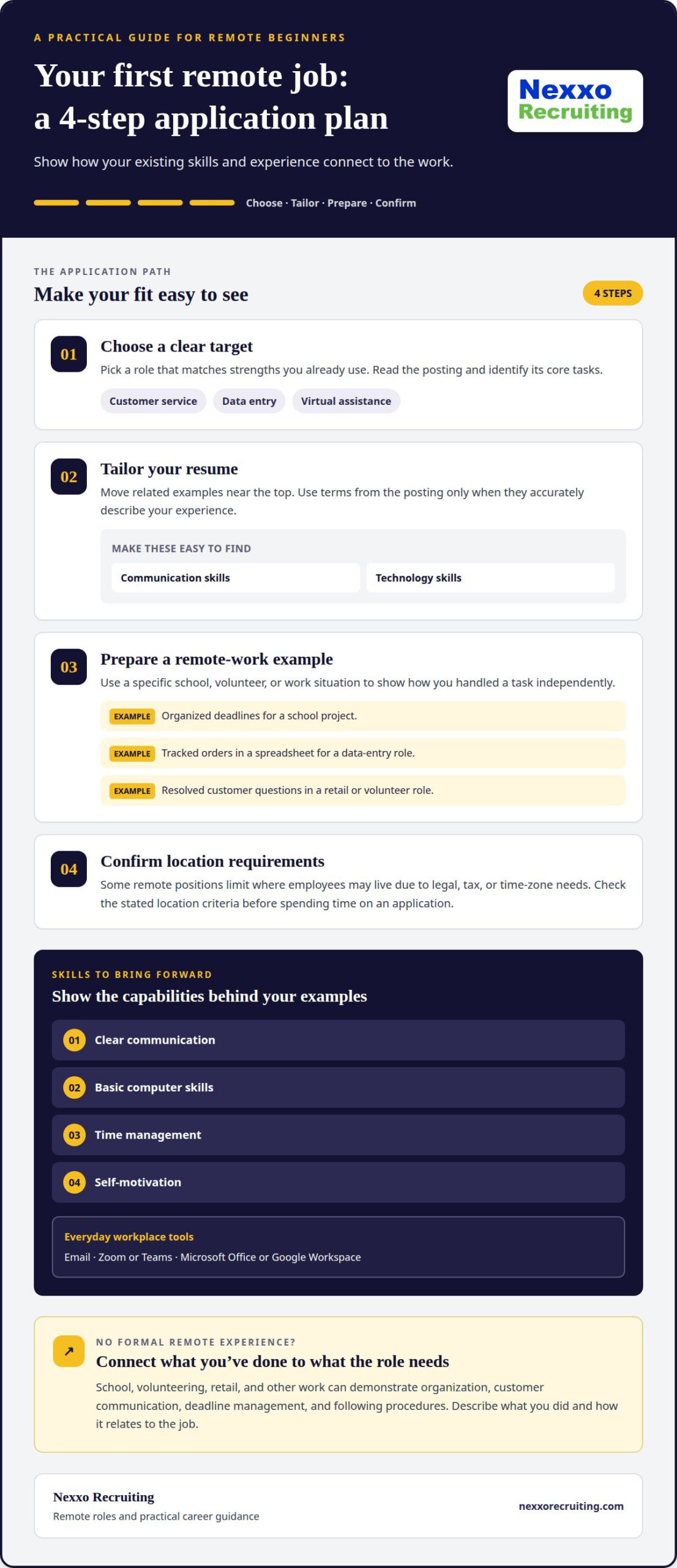
Show evidence that you can communicate clearly, manage tasks, and use everyday workplace technology. Communication, basic computer skills, time management, and self-motivation are useful for remote beginners. Familiarity with email, Zoom or Teams, and Microsoft Office or Google Workspace can also help. Highlight these practical abilities rather than collecting unrelated certificates.
Build your resume around transferable experience, even if you have not worked remotely. A school project can demonstrate organization; volunteering can show customer communication; and a retail role can show how you handled requests and followed procedures. Describe what you did and how it relates to the job. For example, mention tracking orders in a spreadsheet for a data-entry role or resolving customer questions for a support position.
- Choose a clear target. Pick a role that matches your existing strengths, such as customer service, data entry, or virtual assistance. Read the posting and note its core tasks.
- Tailor your resume. Use relevant terms from the posting when they accurately describe your experience. Move related examples near the top, and make your communication and technology skills easy to find.
- Prepare a remote-work example. Explain how you organized deadlines, responded to messages, or completed a task independently. Use a specific school, volunteer, or work example.
- Review location requirements. Some remote positions restrict where employees may live because of legal, tax, or time-zone needs. Confirm the stated location criteria before investing time in an application.
Before applying, check that your resume fits the role and addresses its stated requirements. If the posting asks for email communication or spreadsheet experience, give a relevant example rather than making a broad claim. For remote jobs without experience, a focused application makes your transferable skills easier for an employer to assess.
Avoiding job scams
Take three warning signs seriously: requests for upfront payment, unrealistic pay promises, and vague job descriptions. Pause before sharing personal information or continuing the conversation. For example, a listing that promises unusually high earnings but says little about daily duties gives you no clear basis for assessing the opportunity.
Read the full posting before applying. Look for a clearly defined role, specific tasks, and stated qualifications. A customer-support position might involve answering questions or routing service requests. If a listing promises easy remote work but does not explain the duties, there is too little information to assess. Keep a copy of the posting so you can compare it with later messages.
- Stop at payment demands. Don’t pay to apply, secure a position, or receive promised work materials. An upfront payment request is a warning sign, not a routine application step.
- Assess earnings claims. Compare the promised pay with the duties described. A large promise paired with few details about responsibilities or qualifications deserves caution.
- Look for concrete work. Identify the tasks, role expectations, and application steps. Ask yourself whether the description explains what you would do during a workday.
Keep your application focused on information relevant to the role. Submit your resume through the stated application channel, and do not provide payment details in response to a job offer. If a message changes the duties or introduces a fee, pause and compare it with the original posting. A mismatch is a reason to stop and review, not rush ahead.
When searching for remote jobs without experience, urgency can make a vague promise seem attractive. Slow down, review the actual duties, and assess each request before responding. A clear description gives you something specific to evaluate; a demand for money or unsupported earnings promise does not.
Customer service as an entry point
Remote customer service may suit beginners because some entry-level jobs provide on-the-job training. Training may cover the employer’s products, response procedures, and systems for handling customer questions. Check the posting for the specific tasks. A role supporting online orders, for instance, may focus on delivery updates, returns, or payment questions.
Daily tasks depend on the employer and service channel. You might respond by email or chat, document a customer’s issue, or route a technical question to another team. For example, an e-commerce customer support role could clarify an order’s status and record the outcome. Clear writing matters because customers and coworkers rely on accurate messages.
- Written communication: Explain a process in plain language, such as how a customer can locate an order confirmation.
- Listening and patience: Identify the issue before responding, especially when a customer describes several concerns at once.
- Organization: Record the customer’s question and the action taken, so the next representative can follow the conversation.
- Sound judgment: Recognize when a request needs escalation instead of guessing at a solution.
Prepare for an interview by practicing a concise response to a sample service scenario. Restate the issue, explain what information you would gather, and describe how you would communicate the next step. If you have worked in retail, hospitality, or a school office, connect a specific example of helping someone to the role’s customer interactions. Be accurate about tools you have and have not used.
Before applying, distinguish customer service from sales-focused work. Support roles center on resolving questions or recording service requests, while sales roles may focus on recommending products or responding to prospective buyers. Compare the stated responsibilities and training details to decide which fits you better. A clearly described training process also shows how the employer prepares new hires for its customer workflows.
What jobs can I do remotely without experience?
Entry-level remote roles may include customer service, virtual assistance, data entry, social media coordination, content moderation, online tutoring, transcription, and junior sales development. Each field calls for different strengths. Accurate recordkeeping helps in data entry, while clear writing supports customer messages and social media updates.
Equipment, internet, and residency requirements vary by position. Some employers limit eligibility to certain states for legal, tax, or time-zone reasons. Read each posting for location terms and stated technology needs before applying.
Use the day-to-day tasks to match a role to your skills:
- Virtual assistant: Organize calendars, manage email, or prepare documents. Examples from school clubs or volunteer scheduling can demonstrate organization.
- Data entry: Enter or update records and follow formatting instructions. Practice with spreadsheets can show attention to detail.
- Social media coordination: Schedule posts, draft captions, or monitor comments. A school or community project can provide relevant writing examples.
- Content moderation: Review user submissions against stated guidelines. Careful reading and consistent decision-making matter.
- Online tutoring: Explain a subject you know well and help learners practice. Tutoring classmates can show how you communicate concepts.
- Transcription: Convert recorded speech into written text. Listening carefully and checking spelling support accuracy.
- Junior sales development: Identify prospective customers or respond to inquiries. Clear written communication can support outreach tasks.
To find employers open to beginners, look for postings labeled entry-level and read the experience requirements closely. Some entry-level remote jobs include on-the-job training. A description that explains the training, routine tasks, and communication expectations gives you a clearer picture of how a new hire starts.
Choose one target role and shape your application around its actual duties. For a virtual assistant opening, describe how you organized schedules or documents. For moderation, explain how you followed written guidelines. Specific examples help employers assess your readiness, even if you have not held a remote job title.
Nexxo Recruiting
Nexxo Recruiting lists remote opportunities across customer support, data entry, tech, digital marketing, and virtual assistance. Review each listing’s job details to assess the responsibilities, then use its direct application link to apply. This can help you move from exploring beginner-friendly roles to considering openings that match your skills.
Use the listings when you’ve chosen a target role and want to find relevant openings. Compare the duties and location requirements with your experience, then focus your application on the skills that match. You stay in control of which positions to pursue and how to present your background. If you’re ready to review opportunities, contact Nexxo Recruiting.
Choose Your Next Step With Purpose
Your first remote role can help you gain experience working with a distributed team. Before applying, decide what you want your next position to teach you and which responsibilities you are ready to take on. Use those priorities to choose opportunities that support your longer-term direction.
Approach each application with a clear reason for pursuing it. Track what you learn during the process and use those observations to guide your next decision. A thoughtful search can help you identify remote jobs without experience that align with your goals and build a practical foundation for your career.
The Nexxo Recruiting team focuses on entry-level remote job listings, bringing relevant openings into one place as you consider your next move. Contact Nexxo Recruiting to discuss your options, and take your next step with purpose.
Frequently Asked Questions
How to make $1000 a week remote?
Reaching a high weekly income remotely may involve sales, customer success, specialized virtual assistance, or combining part-time employment with freelance work. These paths differ in schedule and how performance affects earnings. Before choosing one, compare the expected workload, payment structure, and consistency of available assignments. Assess a weekly target against the role’s hours and compensation model.
What remote jobs can you get with no experience?
Some employers consider applicants without formal experience, especially when a posting describes training and focuses on job-related abilities. “No experience” does not always mean “no requirements.” A role may still require specific availability, written communication, or familiarity with a particular workflow. Read the qualifications alongside the duties, then distinguish required criteria from preferred experience before applying.
What entry-level remote jobs are hiring in the United States?
Openings change as employers fill roles or adjust hiring needs, so availability varies by job title. Look for active postings that explain the application process and work arrangement. Note the posting date and whether applications are still being accepted. This helps you focus on current openings rather than listings that may no longer be active.
How much do remote jobs without experience pay?
Compensation depends on the role’s duties, expected hours, employer, and payment structure. Some postings state hourly pay; others describe a salary or commission-based compensation. Compare positions on the same basis, including whether earnings depend on completed work or sales results. The title alone does not tell you what a role pays, so use the posting’s compensation terms to assess fit.
How can you write a resume for a remote job with no experience?
Make every resume bullet specific and accurate. Describe the task, the tools or process involved, and the outcome when you can support it. For example, say you maintained a club’s event calendar rather than claiming broad administrative expertise. Keep dates and role titles consistent, and separate paid work from education and volunteering so employers can understand your background.
How do you apply and interview for remote jobs as a beginner?
Track applications in a simple document with the role title, employer, submission date, and follow-up status. Before a remote interview, confirm the time zone and test your audio and video setup. Keep the job posting handy so you can refer to its duties. Afterward, send a brief thank-you message that mentions a specific point from the conversation.