
To promote remote job openings, write a clear, accurate listing and share it where suitable candidates can find it. Describe the role’s responsibilities, required skills, location eligibility, remote or hybrid expectations, schedule, and application steps so applicants can assess their fit before applying.
Remote work does not always mean work from anywhere, so spell out location or time-zone limits and explain how the role works day to day. This guide covers how to make listings specific, choose suitable channels such as remote job boards, and help qualified candidates quickly judge whether an opportunity fits their experience and circumstances.
Key Takeaways
- Make featured openings easy to assess by stating the role’s requirements, location limits, and remote or hybrid expectations clearly.
- Match each listing channel to the role and audience, then keep the job details consistent wherever you post.
- Define whether candidates can work from anywhere or must live in a specific location before promoting the opening.
- Explore Nexxo Recruiting’s remote job listings for opportunities across data entry, tech, digital marketing, virtual assistant, and customer support roles.
Featured and promoted openings
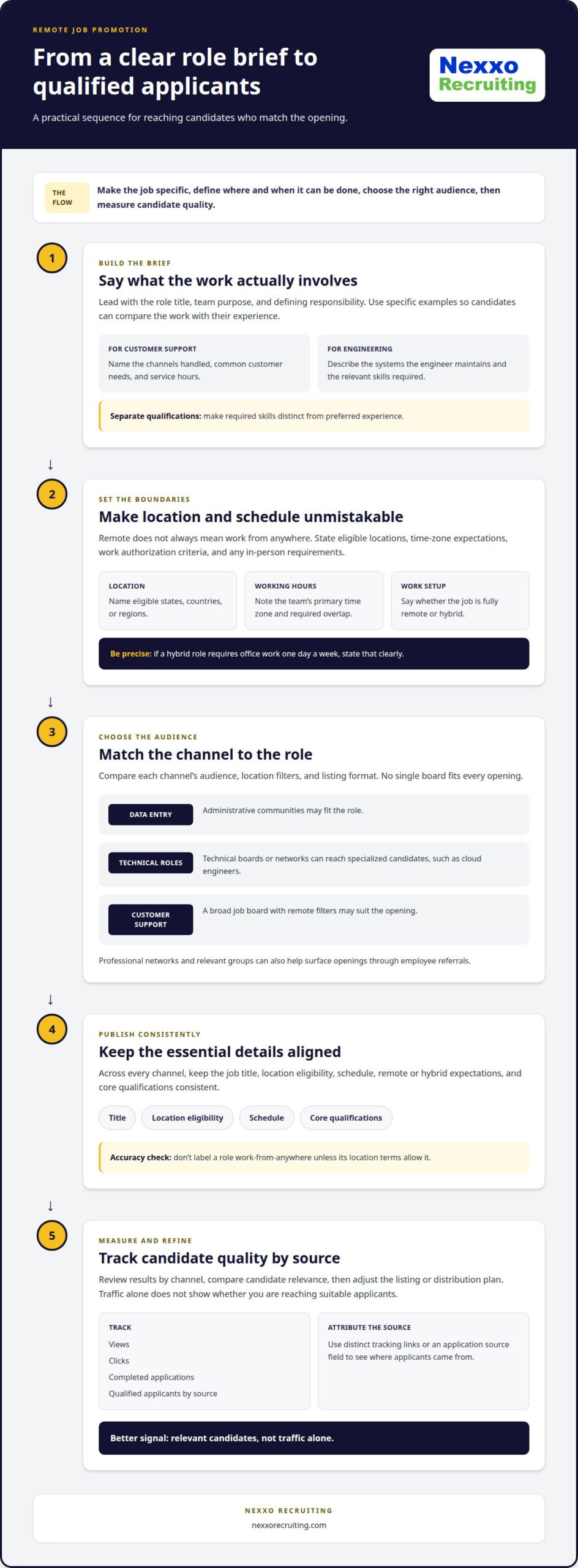
To promote remote job openings, give candidates a specific reason to notice the role. Lead with its title, team purpose, and defining responsibility. Include required skills, location limits, schedule, and remote or hybrid expectations. If a hybrid job requires office work one day a week, state that clearly.
Highlight details that distinguish the work, such as a specialized function or clear team mission. For example, describe the customers a support role serves or the systems an engineer maintains. Specific examples help applicants assess whether their experience matches the position. Keep the headline accurate and closely tied to the actual responsibilities.
Choose a channel based on its audience and listing format. Check whether candidates can see the role’s location eligibility, schedule, and core qualifications before applying. A clear preview helps applicants decide whether to read the full description. Keep these details consistent wherever you share the opening.
On LinkedIn, share the opening with a direct application link. Include the title, location eligibility, and key qualifications, then ask employees to share it with relevant professional networks. Adapt social media posts for each audience while keeping job details consistent. Don’t call a role work-from-anywhere unless that’s accurate.
Employers can promote remote job openings to qualified candidates by matching channels to role requirements. A data entry position may suit administrative communities, while a senior engineering role may need technical networks. Name the required tools, relevant experience, and responsibilities to help candidates assess fit. Keep the post specific enough to attract applicants with relevant skills.
Measure results by tracking views, clicks, completed applications, and qualified applicants by source. Use distinct tracking links or an application source field. Compare candidate relevance across channels, then adjust the listing or distribution plan. Traffic alone does not show whether your promotion is reaching suitable applicants.
For a customer support opening, specify the channels handled, common customer needs, and service hours. This helps applicants assess the role before applying.
Remote job listings
Choose a remote job board based on the role and candidate audience. Specialized boards can attract remote-focused applicants, while general job boards offer broader reach. Professional networks can help surface openings through employee referrals and relevant groups. Match the channel to the position, such as a technical board for a cloud engineer role.
There is no single best board for every U.S. opening. Compare audience focus, location filters, and listing format. A customer support role may suit a broad board with remote filters, while a specialized software role may need a technology-focused audience. Review applications by source to see which channel brings relevant candidates.
For jobs open across multiple states, name eligible states clearly. Remote does not automatically mean candidates can work from any location. Define location limits, time-zone expectations, and any required in-person work. State-specific hiring and workplace requirements can differ, so make sure the posting reflects the role’s actual eligibility and terms.
Write descriptions around the work, not generic claims about flexibility. For a customer support position, specify the channels handled, common customer needs, and expected responsibilities. Separate required qualifications from preferred experience. Include the reporting structure, schedule, application steps, and whether the role is fully remote or hybrid.
Reduce fraudulent applications with a consistent screening process. Verify that applicant information matches the submitted work history, then use structured interviews tied to job duties. For a data entry role, assess accuracy with a relevant task. Keep communication within established hiring channels, and never base a decision on a single isolated signal.
For U.S. openings, use remote-focused boards to reach candidates seeking remote work, general boards with remote filters for broader reach, and technical boards for specialized technology roles. The right choice depends on the position and the audience you want to attract.
Work-from-anywhere opportunities
A work-from-anywhere role can be performed without reporting to a centralized office, but the label still needs clear boundaries. State which countries or regions are eligible and identify any location restrictions. If a role is open only in the United States, say so directly. Don’t describe a position as global when hiring is limited to specific locations.
Disclose the working hours candidates must support, including the team’s primary time zone and any required overlap. Explain whether schedules are fixed or flexible, and note recurring meetings or customer coverage windows. For example, a role serving U.S. customers might require availability during stated U.S. business hours. Candidates can then assess the schedule before applying.
Clarify work authorization expectations. State where applicants may reside, whether they must already have authorization to work in those locations, and whether sponsorship is considered. Keep these details consistent across the job description and application process. For an international opening, name eligible locations instead of relying on “remote” alone.
Examples show why the distinction matters. The Centre for Effective Altruism lists a globally remote Software Engineer position. Practice Greenhealth lists a remote Sales Coordinator position in the United States. Those descriptions signal different location scopes. Use equally precise wording in your listing, then repeat the same eligibility details wherever you promote it.
Before publishing, review the location and schedule fields together. Confirm that the job title, eligible countries, time-zone expectations, and authorization criteria describe the same arrangement. If candidates must attend occasional in-person meetings, state that requirement. Clear terms help applicants assess fit and help hiring teams focus on candidates who meet the role’s actual location needs.
Presenting compensation alongside location scope gives applicants useful context for comparing opportunities and distinguishing globally eligible roles from those limited to the United States. Candidates can review both factors before deciding whether to apply.
Where can employers post remote job openings?
Choose channels based on the role and the candidates you need. LinkedIn can support professional-network sharing and employee referrals. A remote job board can help candidates find openings suited to remote work. For a software engineering role, share the posting in relevant technical communities. For customer support, prioritize communities focused on service careers.
Your company’s careers page gives applicants a central source for role details. Link to the specific opening from LinkedIn posts, employee newsletters, and professional association boards. Keep the title, location eligibility, and application instructions consistent across channels. If an association serves a particular field, share roles relevant to its members.
Social platforms can extend a listing beyond existing followers. Ask team members to share a short post with the role title, core responsibility, and application link. For example, a finance team member might share an accounting opening and note its main duties. Avoid broad claims that obscure the role’s requirements.
Candidate communities can provide a more focused audience. Consider alumni groups, professional associations, and discipline-specific forums. A data entry position may fit a community centered on administrative work, while a technical troubleshooting role may suit a technology group. Follow each community’s posting guidelines and keep the description relevant to its members.
Use a simple channel plan: identify the target role, select relevant channels, and track applicant sources. Record where each applicant found the opening. Compare qualified applications from LinkedIn, a remote job board, and employee referrals, then use the results to refine future distribution. Clear targeting helps you reach candidates without repeating the same generic post everywhere.
Before publishing, decide whether the role is fully remote or includes office work, then make that expectation clear in every version of the posting. A hybrid remote job may require employees to work in the office at least one day a week. Applicants can use that detail to assess whether the role fits their location and working preferences. Keep the wording consistent across the careers page and shared posts, and make the application route easy to find. When reviewing responses, note whether channels are reaching people who meet the stated work arrangement as well as the role requirements.
Nexxo Recruiting
Nexxo Recruiting helps job seekers explore remote opportunities through listings tailored to entry-level candidates. Browse roles by field and review the details before deciding whether to apply. Each posting includes job information and a direct application link.
Start with the work you want to do. Nexxo Recruiting features openings across data entry, tech, digital marketing, virtual assistance, and customer support. If you’re pursuing customer support, focus on listings in that field and read each role’s responsibilities and qualifications. For technology roles, review the requirements in each posting before applying.
Use each listing to assess fit. Compare the role’s duties with your experience, note required skills, and review the application instructions. Understanding the opening helps you decide which opportunities match your goals. Follow the direct application link when you’re ready to apply.
For employers, a listing gives candidates a direct route to role details and an application. Make the job description specific before sharing it, including responsibilities, location eligibility, schedule, and qualifications. Candidates need these details to assess fit, especially when remote work has location or time-zone limits. Keep the listing aligned with the actual role.
Remote job promotion works best when the opening reaches people suited to its requirements. Nexxo Recruiting’s listings give job seekers a focused place to explore entry-level remote opportunities across several fields. Review the relevant postings and use their details to guide your next application. Contact Nexxo Recruiting to learn more about its job listings.
Frequently asked questions
What should employers do when a role changes after publication?
Update the job description and every active post so candidates see current responsibilities and requirements. Close or remove outdated copies to prevent confusion during the application process.
How can hiring teams make remote applications easier to review?
Use consistent application instructions and assess candidates against role-related criteria. This helps the hiring team compare relevant experience and skills without relying on unrelated details.
Should employers keep promoting a role after accepting applications?
Continue sharing the opening while it remains active and the applicant pool needs more qualified candidates. Pause promotion once the position closes, and update any posts that remain active.