
A remote label alone doesn’t make a job legitimate or a good fit. Learning how to find legitimate remote jobs means targeting roles that match your skills, checking the employer and posting carefully, and applying with evidence of your experience. Competition can be demanding, so tailor your application to the actual responsibilities rather than relying on a generic résumé or cover letter. This guide explains how to present relevant skills, find openings through several channels, and assess legitimacy, location requirements, and role fit before applying.
Key Takeaways
- Distinguish fully remote roles from hybrid jobs, and confirm where you must be located before applying.
- Find openings through several channels, then tailor your application to the role’s actual responsibilities.
- Screen listings for clear duties, a verifiable employer, and suspicious requests before sharing sensitive information.
- Research work location requirements and employer details; browse Nexxo Recruiting listings for remote opportunities in fields such as customer support, data entry, tech, and digital marketing.
What jobs are commonly performed remotely?
- Separate fully remote roles from hybrid roles before applying. A remote posting may still define location, scheduled hours, or occasional office attendance. In the United States, 22.4% of people at work teleworked or worked at home for pay during the 2025 annual-average period. That total includes 11.9% teleworking for some hours and 10.5% for all hours during the 2025 annual-average period. According to the U.S. Bureau of Labor Statistics, its 2025 annual estimate of teleworking is an 11-month average because October data were not collected. Read each arrangement’s wording and compare it with your work preferences.
- Target roles whose tasks can be completed through digital systems. Options include data entry, customer support, software development, digital marketing, and virtual assistance. Search for specific duties, such as answering customer inquiries, updating records, or scheduling appointments. Then check whether the posting describes a fully remote role or merely allows occasional work from home. This distinction helps you focus on opportunities that match your experience and preferred work arrangement.
- Build a remote-focused résumé around evidence, not broad claims. For a customer support role, name the channels you’ve handled, such as email or chat, and explain how you resolved customer issues. For data entry, highlight record accuracy, spreadsheet work, and database familiarity. Include examples of independent task management, written communication, and collaboration across locations. Use relevant terms from the posting only when they accurately describe your experience.
- Include contract roles in your search if project-based work suits your circumstances. A contract posting should explain its deliverables, expected schedule, and engagement structure. Compare those details with your availability before applying. Find openings through professional networks and remote-work communities, then assess each listing individually. For example, a former colleague might share a contract opening that matches your CRM experience. Tailor your résumé and screen the role just as you would for an employee position.
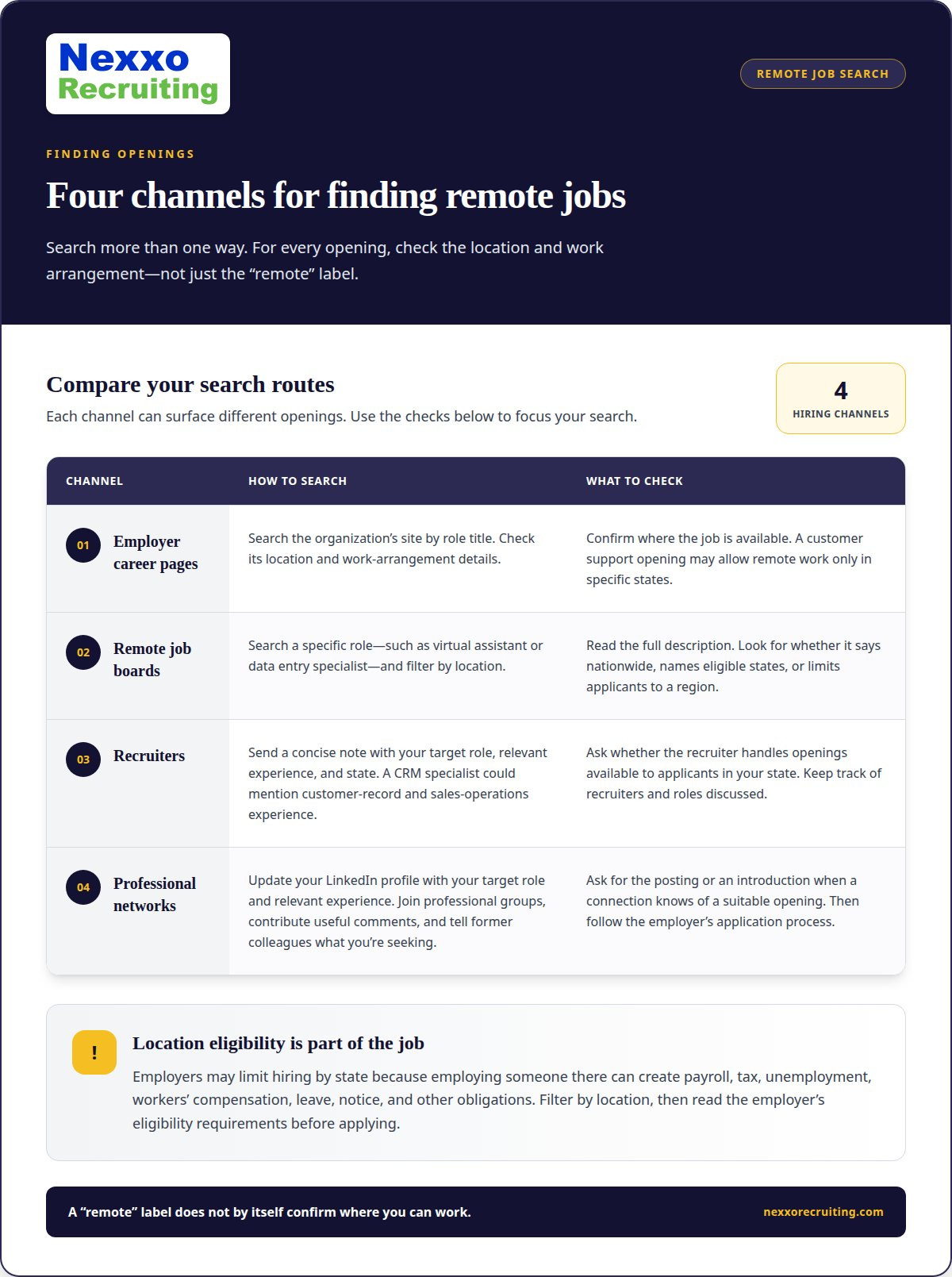
Finding openings through employers, job boards, recruiters, and professional networks
You can learn how to find legitimate remote jobs by searching several hiring channels. To find roles open in your state, filter by location and read the employer’s eligibility requirements. Employers may limit state-based hiring because employing someone there can create payroll, tax, unemployment, workers’ compensation, leave, notice, and other obligations.
- If you’re deciding how to find legitimate remote jobs, start with employers’ career pages. Search the organization’s site by role title, then check the location and work arrangement. A customer support opening, for example, may allow remote work only in specific states. Save the original posting and application route, then compare them with other versions of the job description before applying.
- Use remote job boards to look beyond familiar employers. Search for a specific role, such as virtual assistant or data entry specialist, and filter by location. Read the full description instead of relying on a “remote” label. Note whether the listing says nationwide, names eligible states, or limits applicants to a region.
- Contact recruiters who place candidates in your field. Send a concise message with your target role, relevant experience, and state. A CRM specialist, for example, could mention experience with customer records and sales operations. Ask whether the recruiter handles openings available to applicants in your state. Keep a record of recruiters, roles discussed, and follow-up steps.
- Use professional networks to find referrals and openings shared through industry connections. Update your LinkedIn profile with your target role and relevant experience. Join professional groups, contribute useful comments, and tell former colleagues what positions you’re seeking. A former teammate, for example, may know about a company hiring remotely in your state. Request the posting or an introduction, then follow the employer’s application process.
Screening and curating remote job listings
- Read the full posting before applying, then match each requirement to evidence from your experience. A useful listing explains duties, reporting relationships, schedule, and location eligibility. A customer support role might specify email responses, ticket routing, and escalation. Flag vague phrases such as “various online tasks” for closer review. Save the job title alongside the employer’s name so you can compare versions.
- Compare the listing with the employer’s own career page. Search the exact job title and a distinctive phrase from the description. Confirm that the role, responsibilities, and application process align. If the employer’s page describes a different position, pause before sharing personal details. Record the posting date and application channel so you can track changes.
- Research the employer independently before submitting sensitive information. Find its official website through a separate search, rather than relying only on links in an unsolicited message. Compare the company name, email domain, and recruiter identity across sources. If a recruiter claims to represent a known organization, contact that organization using details you found independently.
- Treat unexpected messages promising easy task income as a warning. The Federal Trade Commission warns about unexpected job-offer texts promising quick money for online tasks. Its 2026 alert about job-offer scams explains this risk. Don’t send money, payment details, or identity documents in response to an unverified text. Stop if the sender pressures you to act immediately.
- Build a shortlist based on role fit and clear terms. Keep postings that match your skills, location, schedule, and preferred employment arrangement. A CRM specialist, for example, might prioritize listings that describe customer records, pipeline updates, and reporting. Remove expired roles, duplicate posts, and listings with unclear duties. Review the remaining opportunities as part of a regular application routine.
What information should I research before applying for a remote job?
- Research what the employer sells and who uses it. A company offering scheduling software may serve clinics, service businesses, or both. Identify the product’s main purpose and customer group, then connect your experience to that audience. This helps you explain your interest in the organization without relying on generic praise.
- Translate the job description into likely work priorities. A customer support role may involve resolving account issues, documenting conversations, or escalating complex cases. Note the central duties and prepare a relevant example for each. For instance, describe a time you organized customer information while handling a request. Keep your examples accurate and specific.
- Review the tools and systems named in the posting. If it lists a customer relationship management platform, spreadsheet software, or support inbox, identify which tools you’ve used and explain how. If you haven’t used a named system, describe a comparable task or tool you know without claiming direct experience.
- Learn how the role fits into its team. Look for details about collaboration, reporting, and handoffs in the description or employer materials. A sales operations specialist, for example, may coordinate with account executives and maintain pipeline records. Use those details to prepare questions about daily coordination and how the position supports team objectives.
- Prepare evidence for the application and interview stages. Choose work samples or examples that demonstrate the skills emphasized in the posting. Practice concise answers that explain your decisions, actions, and results. If the process includes a written exercise, follow the instructions closely and review your work for clarity, accuracy, and completeness before submitting.
Nexxo Recruiting
Nexxo Recruiting’s remote job board features listings for entry-level candidates across data entry, tech, digital marketing, virtual assistant, and customer support roles. Each post includes job details and a direct application link, helping you assess the opportunity before applying.
Use the criteria in this guide to assess each opportunity: check the work arrangement, location requirements, duties, and employer details. Then decide whether the opening matches your skills and preferences. Nexxo Recruiting’s listings can help organize your search, but it’s still important to review each posting and assess the employer before applying. Explore the listings to find remote roles that fit your search.
Turn Your Search Into a Repeatable Process
Set a clear target for your next phase of searching. Choose the role types that fit your skills, the work arrangement you want, and the locations where you’re eligible to work. Keep those priorities visible as you review new openings. A defined target helps you focus on relevant applications instead of reacting to every remote label.
Learning how to find legitimate remote jobs also means learning from each application. Track the roles you pursue, note which requirements match your background, and adjust your approach when postings reveal a skill gap. Use what you learn to strengthen how you describe your experience and choose future opportunities. Stay selective while keeping your search active.
Nexxo Recruiting’s recruiting focus connects job seekers with listings to consider as they plan their next move. Take the next step at a pace that works for you. Contact Nexxo Recruiting about your search and keep building toward a role that fits.
Frequently Asked Questions
How can I stand out for a remote job?
Make your communication and follow-through clear throughout the hiring process. In an interview, give a specific example of how you organized work, shared progress, or resolved a problem without in-person direction. For a writing-heavy role, keep your application clear and error-free. Respond promptly to interview instructions and provide requested materials in the format the employer specifies.
How can I tell whether a remote offer is a scam?
Stop if an offer asks you to pay for training, deposit a check, or move money through your account. Compare the offer with the job description and the employer’s official hiring process. Be cautious if someone pressures you to accept immediately or communicate only through an unusual channel. Don’t share sensitive information until you’ve independently verified who is contacting you.
How can I verify remote job listings?
You don’t need to pay to apply directly through an employer’s careers page. Check the employer’s official website and confirm that the listing includes a clear application route. Before sharing personal information, verify that the employer and role are genuine. You can also search employer career pages and professional networks for openings.
What counts as a remote job?
A remote job is performed away from an employer’s usual workplace, with tasks and communication typically handled online. The label alone doesn’t explain the arrangement: a role might be fully remote, hybrid, or limited to an approved location. Check how often you must attend an office, where you may work, and whether the job has set online hours.
Where is the safest place to find remote jobs?
Start with an employer’s official careers page or a listing that identifies the employer and provides a clear application route. Professional associations and established networks can also surface roles shared by people connected to the organization. Treat any platform as a starting point, not proof of legitimacy. Confirm the employer independently before sending personal information or accepting an offer.
How can I tell if a remote job listing is legitimate?
Look for a specific job title, clear responsibilities, a stated work arrangement, and an identifiable employer. Check whether the same opening appears in the employer’s own hiring materials. Watch for mismatches, such as an interview invitation describing different duties from the listing. A polished post or familiar platform alone doesn’t verify an opening, so assess the employer and application process separately.