
Remote-focused job boards are a practical starting point for finding remote roles. General job boards with remote filters can broaden your search when you’re open to a wider range of positions. The best places to look depend on the role you want and any location or time-zone requirements, so check these details in each listing.
Finding a suitable opening can feel like guesswork, especially when you’re trying to match your skills to a role. This article explains how remote job boards help you find openings and how to assess whether a position fits your needs.
You’ll also learn how to use remote-work resources to guide your search and which listing details can help you tailor your CV. These steps make it easier to focus your applications and improve your chances of getting interviews.
Key Takeaways
- Choose job boards and other channels that feature remote roles in your field.
- Use remote filters, role keywords, and remote-first company lists to find openings.
- Check location eligibility, work expectations, and other details to assess whether a role fits you.
- Focus your search on channels that reach your target audience, and follow each application’s instructions.
Finding the right remote job boards
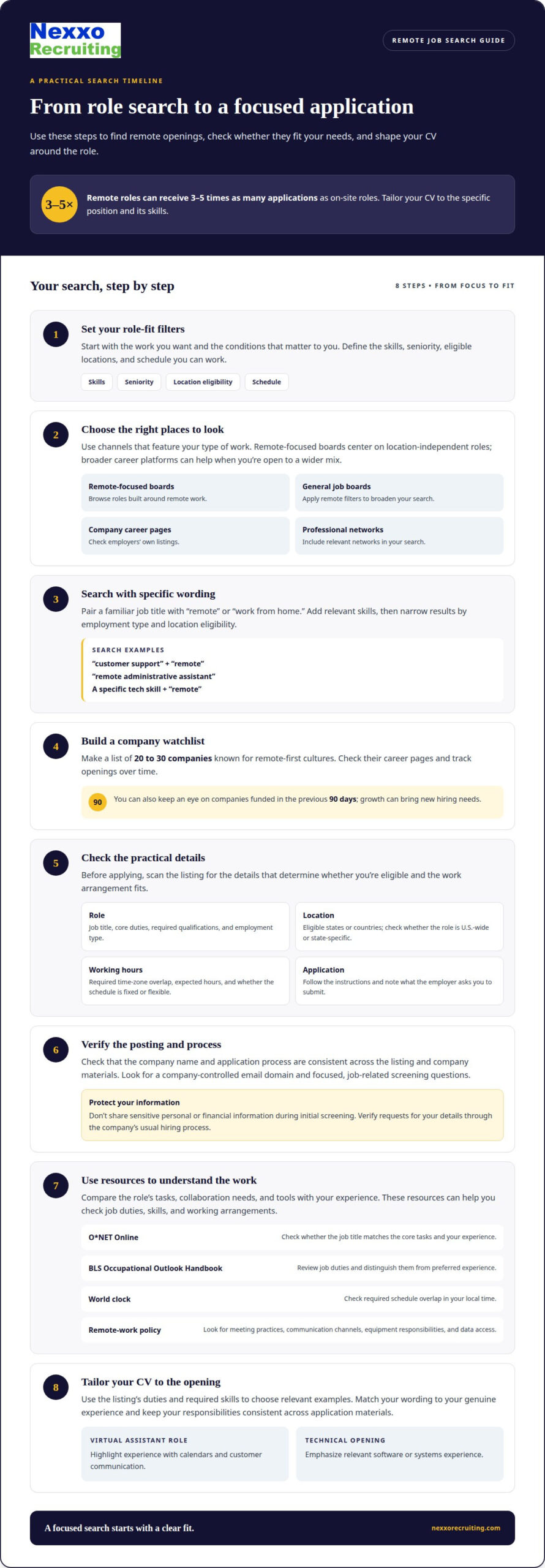
Remote-focused job boards help you find roles that are location-independent. Broad career platforms offer a wider mix, including local roles you can filter by remote work. Remote roles can receive 3-5 times as many applications as on-site roles, so tailor your CV to the position. A data-entry opening calls for different skills than a software engineering position.
Think about what matters to you: location flexibility, a specific schedule, or eligibility to work in certain states. For a virtual assistant role, highlight experience with calendars and customer communication. For a technical opening, emphasize your software or systems experience. Review each board’s categories and filters, and search for clear, familiar job titles to find relevant posts.
In the United States, rules can vary by state and locality depending on where employees may work. Pay-transparency requirements may apply to postings in certain jurisdictions. Check which locations are eligible before applying, and review any pay details in the posting. This helps you decide whether you can apply and whether the role fits your needs.
Before applying, check the job title, core duties, required qualifications, employment type, and application instructions. Look for eligible states or countries, any required time-zone overlap, and expected working hours. For example, check whether a role is open across the United States or limited to a particular state. Review compensation details where listed, and note whether the schedule is fixed or flexible.
Check that the company name and application process are consistent across the posting and company materials. Look for a company-controlled email domain and focused, job-related screening questions. Don’t share sensitive personal or financial information during initial screening. Prepare a relevant example, such as how you would resolve a customer service issue. Match your responses to the stated requirements, then verify requests for your details through the company’s usual hiring process.
Remote job search
When you search for remote work, start with job boards, company career pages, and professional networks. You might begin with a role, such as “customer support,” then add “remote” or “work from home.” Narrow your results by skills, employment type, and location eligibility to find roles that match your needs.
Try making a list of 20 to 30 companies known for remote-first cultures. Check their career pages and follow new openings over time. You may find a role on a company page after seeing it elsewhere, so compare the job title and core details across listings.
Search wording matters. If you’re looking for a virtual assistant role, try “remote administrative assistant” or “virtual assistant, remote.” If you’re pursuing tech work, pair a specific skill with “remote.” Use familiar job titles and look for essential skills in the listing. Don’t rely on “remote” alone to explain the work.
You may also track companies that recently raised funding, since growth can bring new hiring needs. The search guidance here points to companies funded in the previous 90 days. Review the responsibilities, qualifications, and application process to decide quickly whether a role fits. Look for details that are easy to scan.
Follow the search path you’d use: try role-specific terms, apply remote filters, and note which details appear prominently. Check that a posting answers your likely fit questions without requiring extra steps. A remote job listing can give you a direct view of a role’s duties and application route.
Remote work resources
Use remote-work resources to understand a role before applying. Compare its tasks, collaboration needs, and everyday tools with your experience. O*NET Online can help you identify occupational skills and related job titles. The Bureau of Labor Statistics’ Occupational Outlook Handbook describes job duties and training. Use the terminology in these resources to reflect relevant skills and experience in your CV.
Next, learn how the work happens across locations. A time-zone converter such as timeanddate’s World Clock can show the overlap between a U.S. team’s schedule and your time zone. A written remote-work policy can explain meeting practices, communication channels, equipment responsibilities, and data access. These details help you assess the working arrangement before applying and prepare relevant questions.
- Use O*NET Online to check whether a job title matches your core tasks and experience.
- Use the BLS Occupational Outlook Handbook to understand duties and distinguish them from preferred experience.
- Use a world clock to check required overlap in local time, not vague hours.
- Review an employer’s remote-work guide to understand meeting cadence and communication tools.
Industry-specific communities can offer context that broad resources may miss. Software job seekers, for example, can review open-source project communities, while customer-support job seekers can explore service-focused professional groups. Note the skills and terminology members discuss, and use those terms in your CV only when they reflect your genuine experience. This helps employers recognize your relevant skills.
Keep your research current as roles evolve. If a position spans countries, check eligibility and relevant work conditions before applying. For a U.S.-only opening, confirm that your location is eligible. Use the same title and consistent descriptions of your responsibilities and remote-work experience across your application materials so employers get a clear picture.
How to Choose Where to Find Remote Jobs
Choose job-search channels that fit your skills and the role, not simply the number of listings. A specialized board may suit fully remote positions, while a broader platform can help you find jobs that also fit office-based candidates. Start with your needs: required skills, seniority, eligible locations, and schedule. These details help you focus on jobs you can realistically apply for.
Review how each platform organizes listings. Check its job categories, remote filters, and search terms. A customer-support role may appear under support categories, not just a general remote label. If you can filter by location, check that the eligible states or countries match where you can work. A mismatch between the filters and the requirements can waste your time.
Use a focused job-search plan:
- Choose a remote-specific board when remote experience or location flexibility is central to your search.
- Add a role-specific community when you have a distinct skill set.
- Use a broad job platform when you’re open to a wide range of roles.
- Keep your search terms and requirements consistent across every channel.
Assess results by relevance, not application volume alone. Track which channels bring you listings that match your essential qualifications and location. If a source produces many unsuitable opportunities, refine your search or choose an audience that better matches your skills. Keep your application details organized so you don’t miss instructions when applying through different platforms.
For an entry-level remote search, a channel with clear categories for data entry, virtual assistance, or customer support may fit better than a general listing space. Find remote job listings where you can review role details and application instructions together. Choose channels that make roles easy to identify and assess.
How Nexxo Recruiting Can Help
Nexxo Recruiting’s job listings can help you find entry-level remote openings in areas such as data entry, technology, digital marketing, virtual assistance, and customer support. These categories can help you focus your search on roles that match your interests. The team’s role-specific knowledge helps keep listings relevant to candidates seeking entry-level remote work.
A well-matched listing gives you a clear starting point. Each Nexxo Recruiting post includes job details and a direct application link, so you can review the opportunity and follow its stated process. Check the duties, qualifications, location eligibility, and schedule expectations to assess whether the role fits before applying. Use these details to focus your CV on the skills and experience the role asks for.
Nexxo Recruiting is relevant when you’re exploring entry-level remote opportunities. A listing can help you find openings, but you’ll still need to assess each role’s requirements. First identify the kind of work you’re seeking, then consider whether a targeted listing can help you find relevant opportunities.
Before applying, review the essential information:
- Check the job title and the role’s main responsibilities.
- Note the required skills and distinguish them from preferred qualifications.
- Confirm eligible work locations and any schedule or time-zone expectations.
- Review how to apply, including the steps you should follow.
These details help you make an informed decision and understand what the role involves. Nexxo Recruiting’s listings focus on genuine remote opportunities, with sector categories that can help you identify roles suited to your interests. If you find an entry-level remote opening that fits, review its details and follow the application steps.
Make Your Next CV More Effective
Treat each CV update as a chance to focus on the roles you want, not as a fixed formula. The details that matter for a customer-support role may not suit a technical position. As your goals or location preferences change, revisit how you describe your experience and keep your application clear from first glance through submission.
Nexxo Recruiting’s knowledge of remote job categories can help you understand the types of roles available, including entry-level opportunities. Use that context to tailor your CV to the responsibilities and requirements that matter for each role. A clear, relevant CV gives recruiters a practical starting point when they review your application.
Choose an approach that fits your current job search, then make your experience easy to understand. Start with a clear CV tailored to the role and highlight the skills candidates need to show; you can refine it as you learn which details help you get interviews.
Explore remote opportunities with Nexxo Recruiting as you plan your next application. A clear, well-matched CV gives you a stronger starting point.
Frequently Asked Questions
How do I find remote job boards that fit my search?
Remote-focused boards tend to list roles for people seeking location-independent work, while broad platforms offer jobs with varied work arrangements. Compare channels by the types of roles they list and whether they include your preferred location and field. Track which sources lead you to suitable openings, then adjust where you search based on what you learn.
How can I improve my CV for remote jobs?
Start with a clear CV that highlights your relevant skills and experience. Match your CV to the role by emphasizing the qualifications the employer lists, and include details about your remote work experience if relevant. Follow the application instructions and keep your CV consistent with your profile across job platforms. Review your CV regularly and refine it if employers may misunderstand your experience.