
Beginner remote customer support roles in the United States usually involve answering routine customer questions and handling general complaints, not work focused primarily on technical support, according to the U.S. Bureau of Labor Statistics. The estimated average annual salary for remote entry-level customer support is $57,746.
Junior options include customer support representative, account support, and customer support associate positions, with listed pay varying by role. You’ll learn what these jobs involve, see example salary ranges, and compare available work arrangements so you can focus on openings that fit your experience.
Key Takeaways
- Separate routine customer inquiries and complaints from roles centered on technical support before deciding which openings fit your skills.
- Compare junior job titles by their day-to-day responsibilities, not by title alone.
- Assess how experience, role scope, and work arrangement can shape compensation and expectations.
- Choose between part-time, full-time, contract, and freelance work based on the schedule and structure you need.
Customer service and support duties
Customer service representatives handle routine questions, account updates, and complaints. According to the U.S. Bureau of Labor Statistics, these roles exclude jobs focused primarily on technical support. A delayed shipment needs a status update. A software fault may need technical troubleshooting.
Customer service roles handle routine customer needs, while technical support roles diagnose product or system problems. A call center describes a service setting, not a specific duty. Staff there may handle service, sales, or technical support. Read each posting’s duties before applying.
During a shift, you may handle tasks like these:
- Answer customer questions by phone, email, or chat.
- Record account details and earlier troubleshooting steps.
- Use a knowledge base to answer common questions.
- Route complex cases through support ticket triage.
- Explain a return step clearly and document the outcome.
Equipment requirements depend on the employer and communication channel. Common requirements include a computer, headset, and reliable internet connection. Employers set any minimum speed or device standards. Review the posting, then test your connection and audio before an interview.
On your resume, highlight transferable tasks and give examples from retail, hospitality, or volunteer work. Describe how you resolved a complaint or explained a process. Before an interview, prepare a brief example of how you listened, took action, and shared the result.
Watch for scam warning signs in remote job posts. Be cautious if a recruiter demands upfront payment, sends a check for equipment, or uses an email address that conflicts with the employer’s name. Confirm the role and application steps through the employer’s official channels. Don’t share sensitive personal or banking information with an unverified contact.
Pay details can vary across listings, so compare the displayed range with the role and employer. The listed Customer Service Support role at Rhea County School District has a displayed pay range of 35 – 60. The listed Customer Representative Service role at CENTE CORPORATION displays a pay range of 0 – 0. A listed remote customer service representative role at Teleperformance offered 15 – 16 per hour, while a listed remote customer service representative role at OneTouch Direct had an estimated annual salary of 26,000 – 30,000.
Entry-level and junior roles
U.S. listings include customer support associate, customer service representative, account support officer, and client support specialist roles. For beginner remote customer support roles, the title alone tells you little. An associate may answer basic product questions, while a client specialist may help customers manage accounts. Compare the duties before choosing.
Employers often value clear writing, careful listening, patience, and accurate recordkeeping. They may also expect basic computer skills and a willingness to learn ticketing or customer relationship management systems.
Transferable experience can help. Use examples from work, school, or volunteering:
- Describe resolving a customer concern.
- Show how you recorded details accurately.
- Explain a process in plain language.
- Give an example of following instructions.
- Name tools you’ve used for email or scheduling.
Requirements vary by opening. An e-commerce customer support role may focus on order questions, while account support may involve carefully updating records. Read the qualifications alongside the duties to see whether the employer values customer-facing experience, written communication, or familiarity with particular systems.
Build your resume around evidence. Replace “good communicator” with a specific example: describe the situation, your action, and the result. Keep every detail accurate, and don’t claim software experience you lack. For beginner remote customer support roles, transferable examples can show how you handle customer needs and routine processes.
Prepare one concise interview example. Explain how you listened, clarified a concern, and chose a next step. Practice describing how you stay organized while working independently. An example from retail, class, or volunteering can connect your experience to the position’s stated requirements.
Use current listings as a practical check on the range of openings, rather than treating a title as a promise of duties. The listing reports 708 remote entry-level customer support positions in the United States, and reports that 94 new remote entry-level customer support jobs were added in the United States that week. Those figures can help you gauge activity in the search, but each opening still needs its own review.
The entry-level customer support salary estimate for the United States is based on 416 job openings. Treat that estimate as context, not an expectation for every employer or role. Compare the stated responsibilities and qualifications with the compensation details in the opening you are considering. Prioritize positions where the schedule, work arrangement, and daily tasks align with your needs and experience.
What affects remote customer support pay
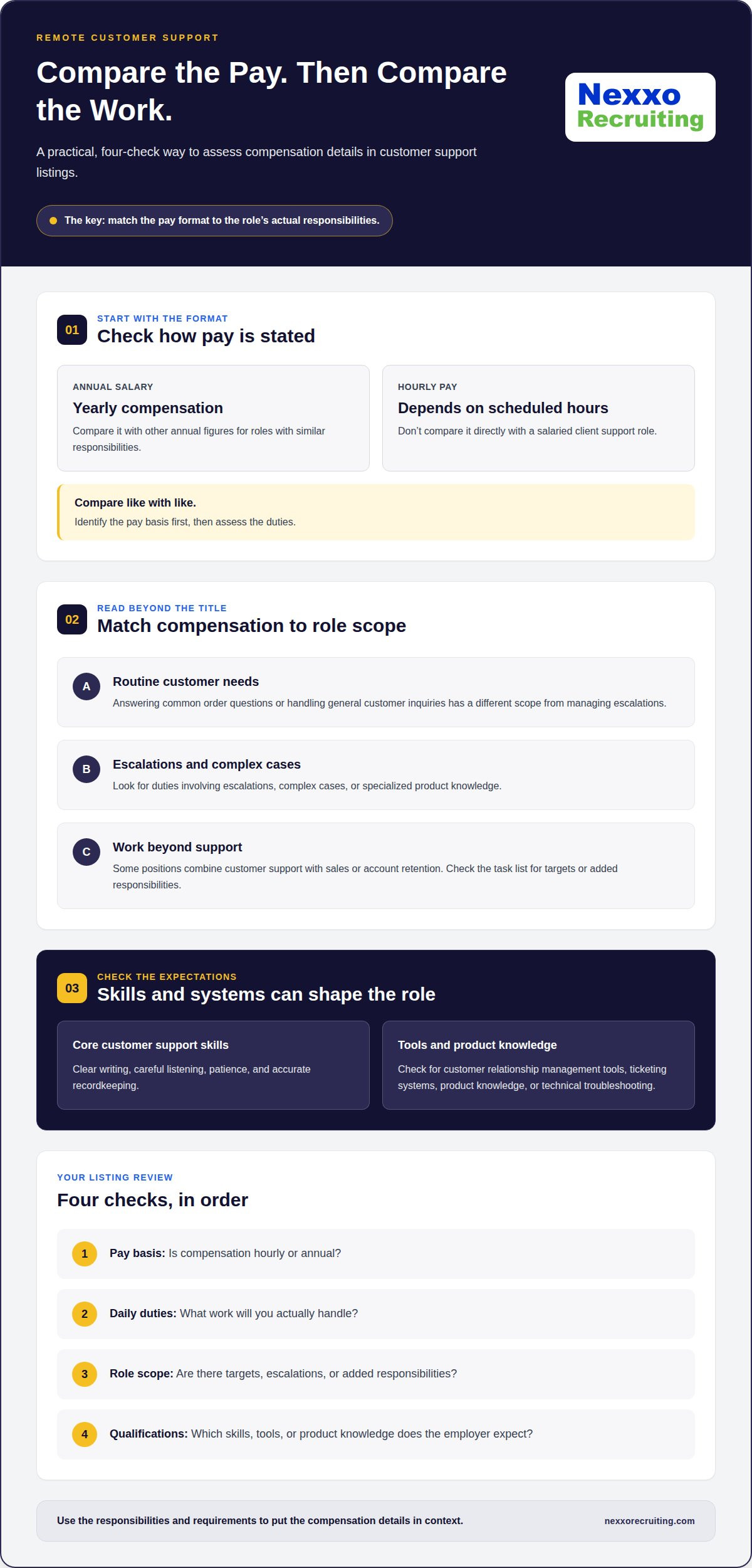
A listing may show an annual salary or hourly pay. Compare like with like: an annual figure covers yearly compensation, while hourly earnings depend on scheduled hours. Don’t compare an hourly call-center role directly with a salaried client support position. Identify the pay basis first, then assess the duties.
The role’s scope can affect compensation. A representative answering routine order questions has different responsibilities from a specialist managing escalations. Some positions also combine support with sales or account retention. Read the task list carefully and note any targets, complex cases, or specialized product knowledge.
Experience and skills matter, too. A junior associate may need clear writing and accurate recordkeeping. A role supporting software users may expect product knowledge or technical troubleshooting. Familiarity with customer relationship management tools can also be relevant. Treat each stated qualification as a clue to the role’s expectations.
- Check whether compensation is hourly or annual.
- Compare duties, not titles alone.
- Look for sales or retention targets.
- Note required systems and product expertise.
- Review schedule, workload, and case complexity.
Work arrangements affect comparisons as well. A part-time opening may list hourly compensation, while a full-time position may use an annual salary. Contract and freelance roles can define the scope differently. Check the posting for expected hours, employment type, and whether pay is tied to performance.
Use a consistent review process. First, note the role title and pay basis. Then compare the core duties and required experience, followed by the schedule and performance measures. This helps you assess the listed compensation against the actual work instead of relying on the title alone.
Part-time, full-time, contract, and freelance work
Part-time support can suit a schedule with limited availability. A student, for example, might cover evening chat while studying during the day. Check the posting for set shifts, weekly hours, and communication channels. A shorter schedule can still involve phone calls, email, or ticket queues.
Full-time roles usually follow a regular work schedule. A customer support representative might answer chats, update records, and attend team meetings throughout the workday. Review expectations for shift coverage, breaks, training, and performance tracking. Remote work still calls for clear communication with supervisors and teammates.
Contract positions define a particular work arrangement or assignment. A company may need temporary help during a product launch or busy service period. Read the contract details for the duties, schedule, project length, and reporting process. Confirm which tasks are part of the assignment before accepting.
Freelance support often centers on agreed tasks or deliverables. For example, a freelancer could answer email inquiries for an online business. The scope may cover response channels, documentation, and escalation steps. Clarify how work is assigned and reviewed, and don’t assume a freelance role follows an employee’s schedule or procedures.
- Part-time: compare shifts with your availability.
- Full-time: review daily duties and team routines.
- Contract: identify the assignment’s scope and end point.
- Freelance: clarify deliverables and review expectations.
Before applying, match the work arrangement to your needs. If you need predictable hours, prioritize postings with defined shifts. If you prefer project-based work, examine contract or freelance duties closely. Note the schedule, communication channels, and supervision model for each opening to see how the work fits your routine.
Nexxo Recruiting
Nexxo Recruiting is a practical next step when you’re ready to find relevant openings. Its platform lists genuine remote opportunities tailored to entry-level job seekers, including customer support roles. The team’s recruiting expertise helps frame the listings around the needs of people starting their remote job search.
Nexxo Recruiting features remote openings across Data Entry, Tech, Digital Marketing, Virtual Assistant, and Customer Support. Narrow your search by field and role. If customer-facing work suits your strengths, focus on support titles and read each post’s details before deciding whether to apply.
Each listing provides job details and a direct application link. Review the responsibilities, qualifications, work arrangement, and application instructions. For example, compare a role focused on customer questions with one requiring product knowledge or account support. This helps you target jobs that match your experience and preferences.
- Start with the Customer Support category.
- Read the duties and stated qualifications.
- Compare the role with your transferable skills.
- Use the direct application link in a relevant post.
A focused search is more useful than applying indiscriminately. Choose openings whose stated duties fit your communication skills, customer-facing experience, and preferred schedule. Keep track of positions that interest you, then follow the application steps in each listing. Nexxo Recruiting’s listings make it easier to identify opportunities and review what each role asks of applicants.
For questions, contact Nexxo Recruiting.
Frequently Asked Questions
What entry-level remote customer support jobs are available in the United States?
Common options include customer support associate, customer service representative, account support officer, and client support specialist. For beginner remote customer support roles, compare the actual tasks rather than relying on the title. One opening may focus on order inquiries; another may involve account updates. Check which customers you’ll assist and which communication channels the posting describes.
How much do entry-level remote customer support representatives earn in the U.S.?
There isn’t one salary that applies to every opening. Use the compensation stated in the individual posting, and distinguish listed pay from a broad market estimate. Before applying, note whether the listing gives hourly or annual compensation. This provides a clearer basis for assessing the position’s stated terms.
Which companies hire beginners for remote customer support jobs?
Available openings change, so search for associate, representative, or client support titles, then check whether the requirements match your experience. Some postings may value transferable skills from retail or hospitality; others may request prior support experience. Focus on the employer and qualifications in each opening rather than assuming a beginner-friendly title guarantees entry-level requirements.
Where can I find legitimate remote customer support job listings?
Nexxo Recruiting lists remote openings for entry-level job seekers, including customer support positions. Each post provides job details and a direct application link. Review the employer, duties, and application instructions before proceeding. A detailed listing helps you assess whether the role suits your background and shows you how to apply.
Are beginner remote customer support jobs full-time, part-time, or flexible?
Flexibility depends on the specific opening, not simply on whether it’s remote. Some employers require applicants to cover defined shifts; others describe availability more broadly. Check the application form for scheduling questions and state the days and time windows you can reliably cover. This helps the employer assess your availability against the role’s needs.