
Remote job listings with salary details put compensation beside the role, employment type, and qualifications, so you can assess the opportunity before applying. Clear salary information matters, but it’s only one part of the decision: the work itself, required skills, and employment arrangement also need to fit your experience and expectations. This guide previews remote roles across marketing, operations, data entry, technology, digital marketing, virtual assistance, and customer support, including available salary ranges, employment types, and the skills or qualifications each may require; use those details to narrow your search to roles that match your capabilities and priorities.
Key Takeaways
- Review featured remote openings by role and compare the listed qualifications with your experience.
- Distinguish employee positions from contract or freelance work before assessing whether a role fits your needs.
- Read salary ranges alongside the pay period and compensation structure to understand what an advertised figure represents.
- Assess job ads for clear employer details, realistic responsibilities, and consistent compensation information before applying.
Featured remote job listings
Featured openings let you compare the role, compensation, and application requirements. Treat the pay figure as specific to that listing, not as a standard for every marketing position. Note the job title, pay period, and employment type, then compare the stated qualifications with your background. Remote job listings with salary details make these factors easier to review together.
Remote opportunities span several fields. Data entry roles may suit candidates who handle records and repetitive tasks carefully. Customer support openings can involve service requests or e-commerce customer support questions, while digital marketing and technology listings call for different experience. Virtual assistant positions may emphasize administrative support. Read each description closely: the title alone doesn’t explain the scope, schedule, or required skills. Compare the compensation with the actual responsibilities.
- Marketing lead: Review the stated base salary, role scope, and required marketing experience.
- Data entry: Look for requirements involving accuracy, records, or data systems.
- Customer support: Identify the channels, customer issues, and communication skills named.
- Virtual assistant: Compare administrative duties with your scheduling and coordination experience.
Use the same process to assess each opening. First, identify the employer and exact job title. Separate required qualifications from preferred ones, then note any location or eligibility language, since “remote” may still come with geographic limits. Compare the duties with skills you can demonstrate through work, projects, or training. This helps you focus on roles that match your experience.
Finally, examine the application process. A useful listing clearly explains the position, qualifications, and next step. Save openings that fit, then tailor each application to the stated responsibilities. For example, highlight customer communication for support roles or careful record handling for data entry. This keeps your shortlist focused on opportunities you can credibly pursue.
Job types and employment status
A remote title describes the work location, not the employment status. A customer support opening may be full-time, part-time, temporary, or contract. Each arrangement affects expected hours, continuity, and work terms. Read the listing’s employment label before deciding whether it fits your schedule. If the label is missing, the description may still explain the commitment through hours, project duration, or ongoing responsibilities.
Full-time and part-time roles differ mainly in expected work hours. A full-time customer support position may require regular coverage on a defined schedule, while a part-time virtual assistant role may focus on specific administrative tasks. Temporary roles address a time-limited need, and contract listings define work through an agreement or project. Don’t assume “remote” means flexible hours or employee status. Look for the specific terms.
- Full-time: Look for a regular schedule and continuing responsibilities.
- Part-time: Identify the stated hours and required availability.
- Temporary: Find the project or assignment period.
- Contract: Review the scope, deliverables, and stated work arrangement.
Remote-first employers organize work around remote participation rather than treating it as an exception. A listing may describe online communication, distributed collaboration, or remote workflows. These details help you understand how the team operates. For example, a digital marketing role might involve coordinating campaigns with colleagues through shared systems. Focus on the responsibilities and communication expectations in the posting, not just the employer’s remote-first label.
Compare the arrangement with your priorities before applying. If you need predictable hours, prioritize listings with clear scheduling language. If you prefer project-based work, assess contract scope and deliverables. Customer support candidates should look for coverage expectations; data entry candidates should identify whether work is ongoing or assignment-based. A remote job listings page can help you scan roles by area and assess their stated employment details.
Salary ranges for remote roles
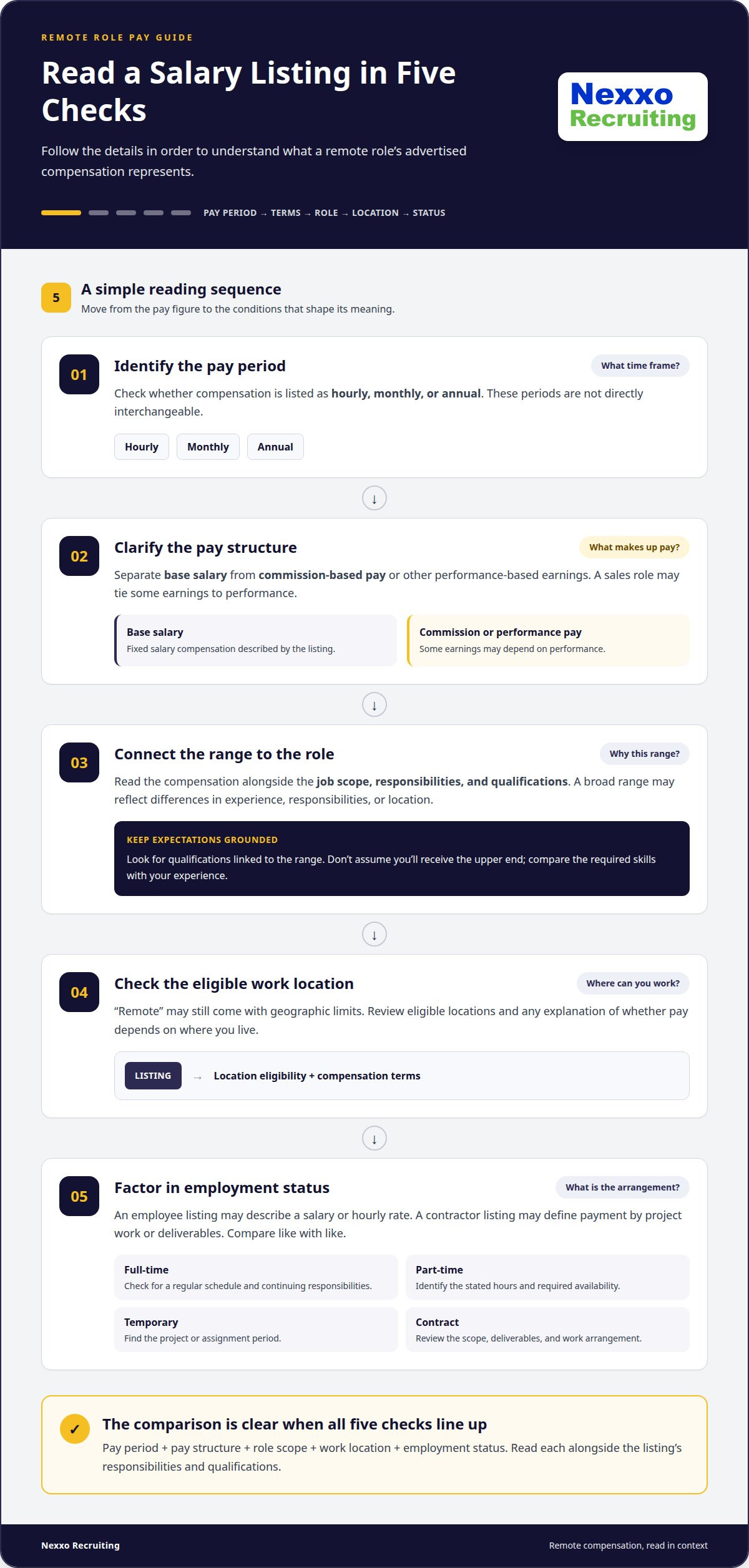
A salary range helps you assess compensation when its terms are clear. Check whether the listing states annual, monthly, or hourly pay, since these periods aren’t directly interchangeable. Identify whether the figure represents base pay, commission-based pay, or both. A sales role with commission-based pay may tie some earnings to performance, while a fixed salary describes base compensation. Remote job listings with salary details are easier to compare when each posting uses clear terms.
Location can affect how an employer sets compensation for a remote role. The posting may limit eligible work locations or explain whether pay depends on where you live. Read that language alongside the responsibilities and experience requirements. This helps you understand what the range represents before comparing it with another opening.
Read the range alongside the job scope. A broad range may reflect differences in experience, responsibilities, or location. Look for qualifications linked to the range. For example, specialized CRM experience may help explain a compensation band. Don’t assume you’ll receive the upper end. Compare the required skills with your own experience.
- Pay period: Identify whether compensation is hourly, monthly, or annual.
- Pay structure: Separate base salary from commission or performance-based earnings.
- Role scope: Match stated duties and qualifications to the listed range.
- Work location: Note eligible locations and how location may relate to compensation.
Employment status also affects how you interpret advertised compensation. An employee listing may describe a salary or hourly rate, while a contractor listing may define payment by project work or deliverables. Compare like with like. An hourly amount doesn’t represent annual earnings without the expected hours and schedule. Review the work arrangement before comparing compensation across openings.
For example, compare customer support roles by pay period, schedule, and responsibilities. One may focus on e-commerce customer support; another may include technical troubleshooting. The titles sound similar, but the work differs. Use remote job listings with salary details to assess stated compensation alongside skills and workload, rather than focusing only on the top of a range.
How can a remote job board help you spot scams or misleading salary ranges in remote job ads?
A remote job board can organize openings so you can assess each posting consistently. Compare the employer name, job title, responsibilities, employment type, and compensation terms. A customer support ad should describe the actual work, not just promise easy remote income. Missing details make it harder to judge whether the role and its pay are a fit.
Look for salary language that defines the pay period and structure. “Annual salary” differs from hourly or commission-based pay. A range should make sense alongside the role’s duties and stated qualifications. For example, a sales listing that advertises high earning potential but doesn’t explain base pay or commission terms gives you little basis for comparison. Treat unclear compensation as a reason to pause.
- Employer: Check whether the company name appears consistently throughout the posting.
- Responsibilities: Match the title to specific duties, such as support ticket triage.
- Compensation: Identify the pay period, range, and any performance-based component.
- Application: Notice requests for sensitive information or payment before hiring.
Watch for pressure tactics during the application process. A message demanding immediate action, personal financial details, or payment to secure an interview deserves careful scrutiny. Compare the stated application steps with the role description. A convincing job title or salary figure alone doesn’t establish that the employer or opening is genuine.
Use listing details to compare similar roles, then look for inconsistencies before responding. For instance, two virtual assistant ads may describe scheduling and inbox management, but only one may explain the work arrangement and pay period. That difference shows which posting gives you enough context to assess the fit. Focus your applications on roles with clear responsibilities and compensation terms. Avoid sharing sensitive information until you understand who is requesting it and why. A board can structure your review, but careful reading remains essential.
Nexxo Recruiting: Job listings
Nexxo Recruiting gives you access to remote job listings focused on entry-level opportunities. Browse openings across data entry, technology, digital marketing, virtual assistance, and customer support. Each listing provides job details and a direct application link, helping you assess the role before applying.
Use these listings when you’ve narrowed your search by role type and want to review opportunities in relevant fields. Compare the responsibilities and qualifications with your experience, then follow the application link for a position that fits. A listing can show you a next step, but the decision to apply remains yours.
For example, if you’re targeting customer support, focus on postings that describe the service work and application process. If data entry fits your skills, review those roles for their stated responsibilities. Contact Nexxo Recruiting to discuss its job listings.
Set a focused direction for your search
Give your search a clear direction. Choose the role types that fit your experience and the work you want to do. Then set a manageable routine for reviewing openings and preparing applications. Remote job listings with salary details can inform your choices, but the strongest next step is to pursue roles that align with your skills and priorities.
Nexxo Recruiting brings together remote job listings across several fields. Use them as a starting point when you’re ready to move from exploring options to considering specific opportunities. Review each role on its own terms and decide which applications deserve your attention.
For help finding relevant job listings, contact Nexxo Recruiting. Take the next step at a pace that works for you, and keep building toward a role that fits.
Frequently Asked Questions
What are the highest-paying remote job listings by role and salary?
The listings don’t establish which remote role pays the most overall. A ranking would require comparable openings across roles, experience levels, and employment arrangements. For a practical comparison, focus on roles at a similar seniority level and assess the full compensation structure, not just the advertised maximum. The best fit depends on your qualifications and the work you’re prepared to do.
What is the average salary for common remote jobs in the U.S.?
There isn’t one meaningful average for common remote jobs across the United States. A data entry position and a technology role involve different responsibilities and qualifications, so combining them can obscure useful differences. Compare openings within the same occupation and experience level. Keep employee and contract positions separate, and use the same pay period when evaluating figures.
Do remote job salary ranges vary by state or location?
They can. Employers may set compensation partly according to where a remote employee lives, and some openings limit eligible work locations. For instance, a posting might accept applicants only from specified states. That geographic condition can affect your eligibility, regardless of your skills. Read location requirements as part of the role’s terms before deciding whether to apply.
What benefits and compensation details are included in remote job listings?
Listings may describe benefits separately from wages. Examples include health coverage, paid time off, retirement plans, equipment expectations, and schedule policies. Benefits vary by employer, so look for terms tied to the specific position. If a posting mentions a benefit, note whether it applies to the employment arrangement offered. This helps you compare the overall package without treating benefits as extra salary.