
Remote catalog data entry jobs involve maintaining accurate, usable product records in digital catalogs. They may suit you if you enjoy focused computer-based work, but typing is only one part of deciding whether a position matches your skills and expectations.
A remote title alone doesn’t explain the work. Employers define duties, experience requirements, supervision, and workflows differently, so compare complete job descriptions rather than relying on a role name or general label.
Use this guide to assess your relevant skills and experience, understand how employment arrangements and schedules may affect your routine, and identify which benefits matter to you. It also explains how to evaluate listings and apply with clear expectations. Screen openings against your needs before spending time on applications.
Key Takeaways
- Assess your accuracy, attention to detail, and ability to follow repeatable processes when evaluating catalog data entry roles.
- Match your experience to each listing’s requirements; some roles may suit beginners, while others call for related work history.
- Compare full-time, part-time, and freelance arrangements by considering the hours, workload, and structure that fit your routine.
- Review benefits separately from schedule and pay, since offerings can differ by employer and employment arrangement.
Data entry skills
Catalog data entry turns product information into organized digital records. For an item, you might enter its name, category, dimensions, color, and description. Follow field definitions closely, since similar terms can correspond to different catalog values. Check identifiers against the source record, then save changes using the employer’s process.
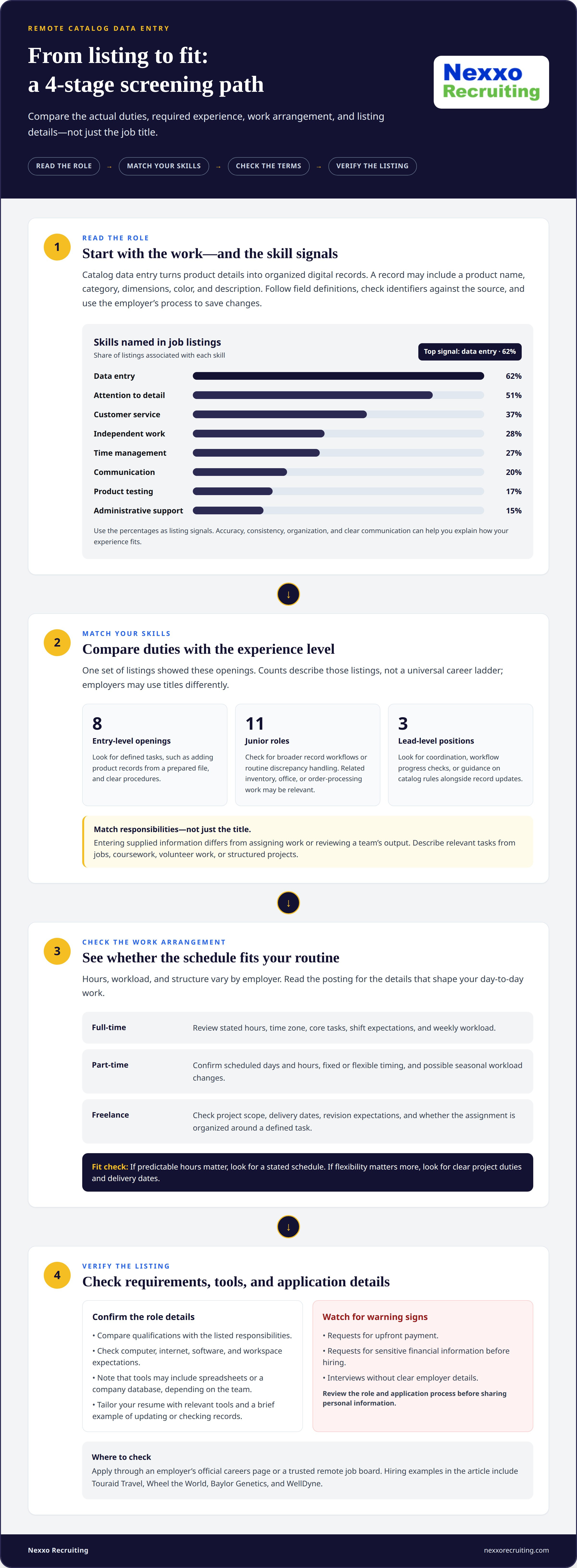
Job listings associate data entry with 62% of roles and attention to detail with 51%. Customer service appears in 37%, independent work in 28%, and time management in 27%. Communication is listed for 20%, administrative support for 15%, and product testing for 17%. These figures point to accuracy and dependable task handling as useful strengths.
- Accuracy: Match a product’s listed size to its source information.
- Consistency: Apply the same category rules to similar items.
- Organization: Track which records need entry, review, or correction.
- Communication: Flag an unclear product detail for supervisor review.
Tailor your resume to the posting. Name spreadsheet or database tools you’ve used, and briefly describe a time you updated records or checked entries. Explain your process, such as comparing fields with a source file. Highlight relevant experience even if your previous job had a different title.
Reduce scam risk by applying through an employer’s official careers page or a trusted remote job board. Requests for upfront payment, sensitive financial information before hiring, or interviews that lack clear employer details are warning signs. Review the role description and application process before sharing personal information.
Equipment requirements vary by employer. Check the posting for computer, internet, software, and workspace expectations. A catalog role may use spreadsheets or a company database, but tools differ across teams. Hiring examples include Touraid Travel, Wheel the World, Baylor Genetics, and WellDyne, for titles such as data entry clerk or item entry technician.
Experience levels
Listings classify data entry roles as entry-level, junior, or lead. One set shows 8 entry-level openings, 11 junior roles, and 3 lead-level positions. These counts describe listings, not a universal career ladder. Employers can use titles differently, so read the qualifications and responsibilities before deciding which level fits your background.
Entry-level postings may focus on defined tasks, such as adding product records from a prepared file. You can draw on relevant experience from coursework, volunteer administration, or another structured task, even without a catalog job title. Organizing event inventory, for example, can demonstrate that you know how to maintain consistent records, even if the items weren’t commercial products.
Junior roles may involve handling a wider range of records or resolving routine discrepancies. A posting might ask you to update several product fields and route exceptions for review. Experience in inventory control, office administration, or order processing can show familiarity with these workflows. Relate your past tasks to the listed duties instead of relying on your former title.
Lead-level positions may involve coordination as well as individual record updates. A lead could assign batches, monitor workflow progress, or guide colleagues on catalog rules. Look for these responsibilities in the description. If you’ve coordinated a shared project or documented a repeatable process, explain your role and the outcome.
- Entry-level: Look for defined tasks and clear procedures.
- Junior: Match related experience to broader record workflows.
- Lead-level: Identify coordination, workflow oversight, or team guidance duties.
Use the job description to assess the role’s level. Entering supplied information is different from assigning work or reviewing a team’s output. Choose positions whose duties match what you can demonstrate. Titles vary between employers, so compare responsibilities and qualifications rather than assuming “junior” or “lead” means the same thing everywhere.
Full-time, part-time, and freelance work
Full-time catalog roles may suit you if you want regular hours and ongoing responsibilities. U.S. listings include full-time data entry positions, but schedules and duties vary by employer. Before applying, review the stated hours, time zone, core tasks, and shift expectations. Updating product records throughout the workday may require a different routine from completing a short catalog cleanup project.
Part-time work can fit around classes, caregiving, or another job. Check the weekly hours, scheduled days, and whether the workload changes during busy periods. A retailer, for example, may need extra catalog updates before a product launch. Find out whether the posting describes fixed shifts or flexible hours, and whether the work is year-round or tied to a project.
Freelance work is often organized around a defined assignment rather than an employee schedule. Read the agreement for project scope, delivery dates, revision expectations, and payment terms. One catalog assignment might involve entering a set of product records by a deadline; another could involve reviewing descriptions and correcting inconsistent fields.
- Full-time: Review shift expectations, weekly workload, and time-zone overlap.
- Part-time: Confirm scheduled hours and possible seasonal workload changes.
- Freelance: Clarify project scope, deadlines, revision process, and payment terms.
Compare the arrangement with your routine before applying. If predictable hours matter, prioritize postings that state a set schedule. If flexibility is more important, look for project duties and clear delivery dates. Someone balancing classes, for example, may prefer updates assigned in batches, while a worker seeking steady daily tasks may prefer a full-time opening. Treat the terms as specific to each role and assess whether the workload fits your availability.
Job benefits
Benefits depend on the employer and employment arrangement. Compare the written offer rather than making assumptions about remote work. A full-time employee package, for example, may differ from a freelance agreement. Review benefits alongside the schedule and duties before deciding.
There is no single useful average for catalog data entry pay. Compensation depends on experience, employment type, workload, and whether the role includes duties beyond catalog updates. Compare positions with similar responsibilities, then weigh the stated pay structure against the hours and benefits.
Check whether the posting or offer explains these areas:
- Health coverage: Review eligibility, enrollment timing, and the plans offered.
- Paid time off: Look for leave rules and how requests are handled.
- Retirement benefits: Check whether the employer offers a plan or contributions.
- Training: Identify onboarding, system instruction, and ongoing learning expectations.
- Equipment: Confirm whether required devices or software are provided.
Remote work alone does not make a complete benefits package. Working from home can reduce commuting, while internet access, workspace, and equipment still shape your routine. Compare, for example, a role with set shifts and employer-provided equipment with freelance work that has project deadlines and a self-managed setup.
Employment status matters. A full-time role may include employer-sponsored benefits, while eligibility for part-time benefits can depend on the employer’s policies. Freelance agreements often set out deliverables and payment separately from employee benefits. Read the written terms for coverage, leave, training, equipment, and hours.
Build a comparison table before accepting an offer. Include pay basis, expected schedule, benefits, equipment, and workload. Two catalog roles may involve similar tasks but differ in paid leave or training. Comparing the same categories helps you see which role best fits your priorities and working routine.
Nexxo Recruiting
Nexxo Recruiting lists remote openings for job seekers exploring data entry and related roles. Each listing includes job details and a direct application link, so you can review responsibilities and requirements before applying.
Use the listings to compare opportunities by role, experience level, and work arrangement. Openings span Data Entry, Tech, Digital Marketing, Virtual Assistant, and Customer Support, giving you the option to consider adjacent roles that match your skills.
Review each posting’s duties and application instructions, then choose roles that fit your experience and preferred schedule. For questions about finding a suitable listing, contact Nexxo Recruiting.
Make your next search more focused
Make your job search repeatable. Keep a simple record of interesting roles, requested qualifications, and your application status. This can reveal which job titles fit your background and where to adjust your search. Set a routine that works for your schedule, then revisit it as new opportunities appear.
As you search for remote catalog data entry jobs, use each listing to assess how well the role fits your priorities and experience. Nexxo Recruiting connects job seekers with remote opportunities through job listings. A clear search target can help you focus on openings that match the work you want to do.
Take the next step at your own pace. Explore job listings with Nexxo Recruiting and keep moving toward a role that fits your goals.
Frequently Asked Questions
What does a remote catalog data entry job involve?
You maintain organized, accurate product records in a company’s catalog system. A typical assignment might involve adding an item, updating its description, or correcting a category after a product change. Some roles also compare records with source documents or flag missing information for review. The exact tasks depend on the employer’s catalog and workflow.
What qualifications and skills are required for remote catalog data entry jobs?
Requirements vary, but employers commonly look for accurate keyboarding, careful record handling, and clear written communication. Familiarity with spreadsheets or inventory databases can help demonstrate your readiness. For example, describe how you organized product information or corrected inconsistent entries in a past role, class project, or volunteer task. Follow the listed requirements instead of assuming every employer expects the same background.
Where can I find legitimate remote catalog data entry jobs in the United States?
Find openings on employer career pages and remote job boards. Nexxo Recruiting lists remote roles in areas including Data Entry, with position details and direct application links. Before sharing personal information, check that a listing identifies the employer, explains the work, and provides a clear application process. Avoid offers that ask you to pay to apply or provide unusual financial details upfront.
Are remote catalog data entry jobs usually full-time, part-time, or contract?
These roles can be full-time, part-time, or contract, depending on the employer’s workload. A business adding products to a live catalog may need ongoing support, while a catalog cleanup may be project-based. Check the posting for employment type, expected hours, project duration, and whether work is assigned continuously or in batches. These details help you compare opportunities accurately.
What tools and software do catalog data entry workers use?
Tools depend on the employer’s catalog process. You may use spreadsheet software, a product information management platform, an inventory database, or an online store’s administrative system. Some teams also use shared documents or messaging tools to resolve unclear entries. A posting may name required programs; if it doesn’t, highlight the systems you’ve used and your ability to learn structured workflows.