
Remote, entry-level medical data entry work involves recording and validating patient information, maintaining accurate records, and supporting healthcare administration. The U.S. Bureau of Labor Statistics describes medical records specialists as validating and entering health information into electronic health record systems. In medical data entry at the remote entry level, accuracy matters, as does careful handling of sensitive information and clear communication when a record needs attention.
This work may suit you if you’re organized and comfortable with computer-based records. The U.S. Department of Labor describes administrative and clerical work as preparing, transferring, organizing, and preserving written and computerized records. This article explains the core skills, administrative duties, and privacy practices involved, so you can assess your readiness and know what to look for in an entry-level remote opening.
Key Takeaways
- Build accuracy habits by entering information carefully and flagging records that need clarification.
- Protect patient information by following workplace privacy procedures and handling records only through approved workflows.
- Expect administrative tasks to include organizing, transferring, and maintaining written or computerized records.
- Review remote job listings closely to match your skills and experience with the role’s stated duties and requirements.
Data accuracy and integrity
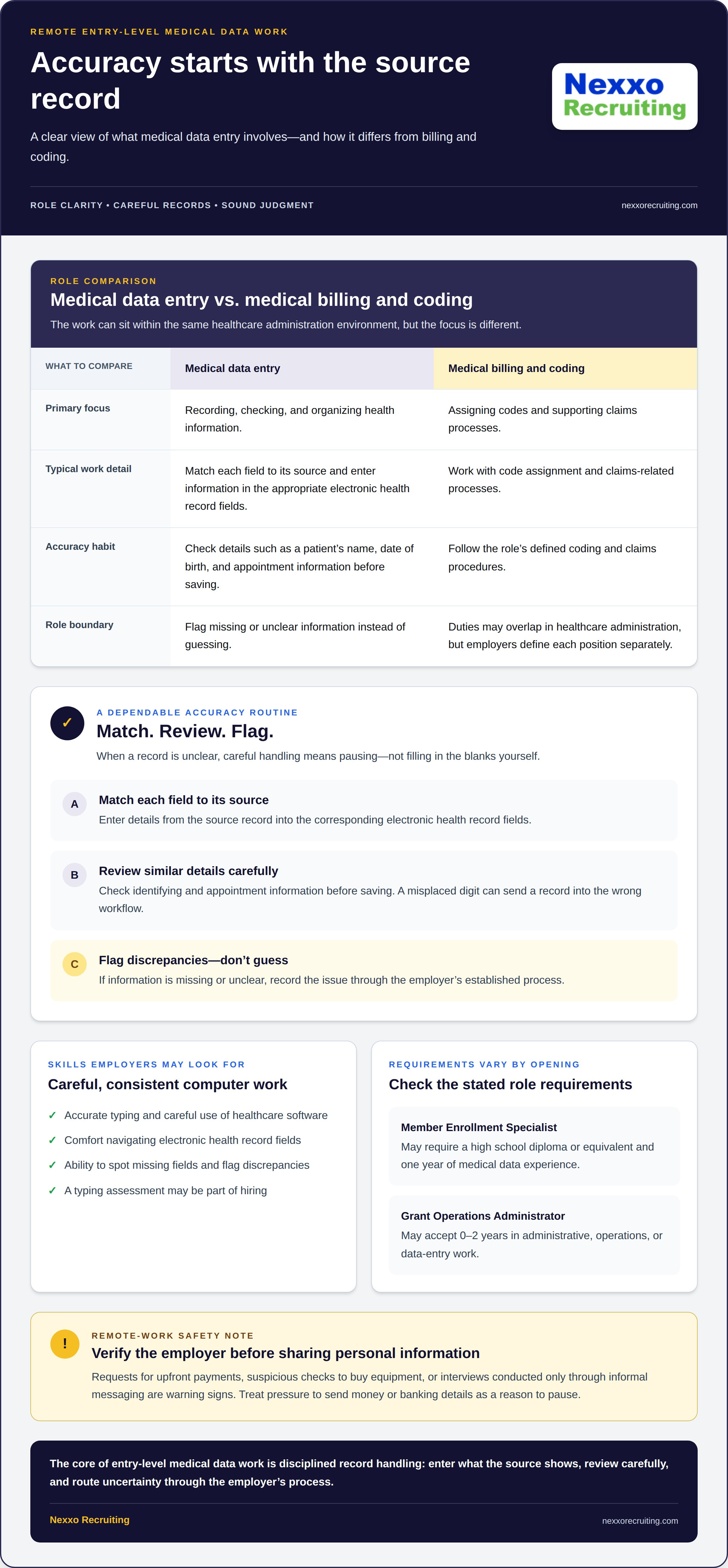
Accurate data entry means matching each field to its source, not guessing when information is unclear. The U.S. Bureau of Labor Statistics says medical records specialists validate and enter health information into electronic health record systems. For example, a data-entry worker might compare a patient’s name, date of birth, and appointment details with the record before saving changes. A misplaced digit can send a record into the wrong workflow, so careful review is essential.
Medical data entry is different from medical billing and coding. Data entry focuses on recording, checking, and organizing information; billing and coding roles assign codes and support claims processes. Duties can overlap in healthcare administration, but employers define each position separately.
A degree or certification is not a universal requirement across entry-level openings. Requirements depend on the role: a Member Enrollment Specialist position may require a high school diploma or equivalent and one year of medical data experience, while a Grant Operations Administrator role may accept 0-2 years in administrative, operations, or data-entry work.
Employers may look for accurate typing, careful use of healthcare software, and the ability to navigate electronic health record fields without confusing similar details. Focus on entering information consistently, spotting missing fields, and flagging discrepancies rather than guessing. A typing assessment may also be part of the hiring process.
Remote-job scams may involve requests for upfront payments, suspicious checks to buy equipment, or interviews conducted only through informal messaging. Before sharing personal information, verify that the employer and posting are genuine. Treat pressure to send money or banking details as a warning sign.
HIPAA compliance
Remote medical data entry can involve patient information, so privacy procedures are part of the daily work. HIPAA appears in many healthcare job descriptions, but the label alone doesn’t define every task. Follow the employer’s training and written workflows. For example, use only the assigned account to enter information into an approved system.
At home, protect the work environment as carefully as the screen. Keep patient records out of household members’ view, and don’t discuss cases where others can hear. Use the access method and devices specified by the employer. If a message or file arrives through an unexpected channel, pause and follow the organization’s instructions instead of forwarding it elsewhere.
- Open only records needed for your assigned task.
- Keep usernames and passwords private, and follow workplace sign-in steps.
- Send information only through the communication channels designated by the employer.
- Lock the workstation when stepping away, and secure any printed material according to workplace procedures.
- Report a misdirected message, unexpected file, or possible exposure through the employer’s stated process.
These practices help keep patient information within approved workflows. For example, if an email contains a patient attachment but doesn’t match the task instructions, don’t download or forward it. Stop and use the organization’s designated reporting route. The right response depends on workplace policy, so learn that process during onboarding.
Hiring teams may assess whether you can handle sensitive records consistently, follow instructions, and recognize when a situation is outside your assigned duties. Give specific interview examples, such as following access limits or escalating an unfamiliar request. In entry-level remote medical data entry, sound judgment matters alongside routine computer skills. Treat privacy as an ongoing work practice, not a one-time checklist item.
Gainwell Technologies may require applicants to complete a data-entry and typing-proficiency assessment during hiring. Follow the instructions carefully and focus on accurate, consistent work rather than rushing. The assessment is separate from the employer’s privacy procedures. Once the job begins, continue to follow assigned access limits, approved workflows, and the organization’s reporting process for anything unfamiliar or out of place.
Healthcare administrative support
The U.S. Department of Labor describes administrative and clerical work as preparing, transcribing, transferring, organizing, and preserving written and computerized records. In a healthcare setting, these functions can support patient intake, appointment workflows, and record maintenance. For example, an entry-level worker may transfer details from a completed form into the matching fields in a digital record.
The U.S. Bureau of Labor Statistics says medical records specialists validate and enter patients’ health information into electronic health records systems. Administrative tasks may also involve organizing documents, routing information to the right team, and keeping records easy to retrieve. The exact workflow depends on the job posting and the employer’s procedures.
- Record updates: Enter a revised phone number or address in the correct patient record.
- Document routing: Send a scanned intake form to the designated department queue.
- Appointment support: Update scheduling details when an authorized change arrives.
- Information tracking: Record whether a required form has arrived or still needs follow-up.
- File organization: Apply the employer’s naming and filing conventions to digital documents.
Remote administrative support relies on clear handoffs. If a document lacks a required field, record the issue through the workplace’s established process rather than inventing an answer. If a scheduling update conflicts with the existing record, route it for review. These steps keep routine tasks moving without changing clinical decisions or making assumptions about patient care.
Job descriptions may use titles such as medical data entry clerk, records assistant, or administrative support specialist. Read the duties closely: one opening may focus on transferring forms, while another includes document organization and appointment coordination. Compare the required tools and daily tasks with your experience in office software, file handling, and detail-focused administrative work.
For an interview, prepare a specific example of organizing records or correcting a clerical mismatch. Explain the steps you took, such as spotting the inconsistency, following the process, and documenting the handoff. This shows how you approach healthcare administration without claiming clinical expertise.
A Data Entry Health Support job in Los Angeles, California, lists pay of 18.75 – 21 per hour. Consider this range alongside the duties, tools, and experience requirements when evaluating a role.
Medical documentation
A remote medical data entry clerk transfers, organizes, and updates healthcare information in electronic records. Tasks may include entering details from intake forms, sorting documents into the right files, and routing incomplete records for review. The work involves documentation, not clinical decisions.
Medical documentation starts with a source, such as a registration form or an authorized update. The clerk identifies the correct record, enters the supplied information in matching fields, and follows the employer’s process for saving or routing the entry. For example, a completed form may provide a patient’s contact details, while a separate document contains appointment information.
Different documents call for different handling. A job description may include work such as:
- Transferring patient details from forms into designated record fields.
- Sorting digital documents by their assigned category or destination.
- Recording whether a required form has arrived or needs follow-up.
- Routing unclear or incomplete information through the designated review process.
- Updating a record when an authorized change is received.
Consistent formatting makes records easier for authorized staff to find and use. Follow the organization’s field labels and file-naming conventions. If an intake form lists an apartment number in the wrong field, don’t silently change the source document or guess where it belongs. Use the workplace’s process to flag the mismatch.
Documentation also requires clear handoffs. If a file is missing a signature or required page, record the issue in the designated workflow. Keep the note specific: identify the document and missing item without adding an opinion about the patient or the cause. This gives the next staff member a useful status update.
Read job descriptions for verbs such as enter, transcribe, scan, organize, and route. Those terms help distinguish documentation-focused work from positions centered on billing, coding, or clinical support. Before applying, match each listed task to a relevant example from school, office, or records work. Review remote openings that describe documentation duties clearly.
Nexxo Recruiting
Nexxo Recruiting helps you move from understanding the role to finding relevant openings through remote job listings. Explore its listings when you’re ready to compare entry-level opportunities with your skills, experience, and preferred duties. Each posting includes job details and a direct application link, so you can review the stated requirements before applying.
For medical data entry roles, focus on the listed record tasks, software expectations, privacy procedures, and experience criteria. A role centered on document organization may suit you better than one requiring prior medical-data experience. Read each posting carefully and apply directly when its requirements match your background.
Contact Nexxo Recruiting to discuss your search for remote entry-level medical data entry opportunities.
Make your next move with confidence
Turn your interest in remote entry-level medical data entry work into a focused job search. Decide which duties fit your experience, then prioritize openings with clear responsibilities and application instructions. A role involving document organization may be a better starting point than one requiring prior medical-data experience. Base your search on the qualifications each employer actually lists.
Nexxo Recruiting’s job listings can help you find remote openings and review details before applying. Use each posting to assess the day-to-day tasks, stated requirements, and application process. The platform focuses on remote listings tailored to entry-level opportunities, giving you a direct next step as you explore suitable roles.
Contact Nexxo Recruiting to discuss your search for remote medical data entry opportunities. Take the next step when you’re ready, and apply to roles that match your skills.
Frequently Asked Questions
Where can I find legitimate remote medical data entry jobs?
Look for postings that identify the employer, describe the duties, and explain how to apply. Compare the title and requirements with information on the employer’s own careers channel. Check that the posting clearly states where applicants can work and what the role involves. These details help you assess whether an opening fits your search before sharing personal information.
How can I apply for remote medical data entry jobs with no experience?
Choose openings that explicitly accept entry-level applicants, then tailor your application to their stated requirements. Highlight relevant coursework, volunteer administration, customer record handling, or spreadsheet tasks. Describe what you did and which tools you used. If a posting includes an assessment, practice with non-patient sample data and focus on accuracy rather than speed.
Do remote medical data entry workers handle protected health information under HIPAA?
Some roles involve protected health information, while others focus on general administrative records or enrollment details. The information handled depends on the employer’s workflow and assigned duties. Review the role description and ask during the interview what types of records the position processes. Don’t assume every medical data entry opening involves the same information or responsibilities.