
Weekend remote customer service jobs combine customer support with scheduled weekend coverage. Hours vary by employer and role. You may answer questions by phone, email, or chat, resolve order or account issues, document interactions, and route requests that need additional support.
Remote work still calls for reliable communication, a suitable work setup, and availability for assigned shifts. Review each listing’s days and hours, time zone, support channels, and equipment or experience requirements to find a role that fits your schedule.
Key Takeaways
- Review each listing’s assigned days, shift hours, and time zone to judge whether the schedule fits your availability.
- Explore roles such as phone support, email support, and e-commerce customer support to find work that matches your strengths.
- Highlight clear communication, accurate documentation, and experience with customer service tools in your application.
- Browse Nexxo Recruiting’s remote job listings for customer support opportunities, then choose a role that aligns with your schedule.
Weekend Remote Customer Service Jobs
Weekend remote customer service jobs let you support customers from home on weekends. Typical tasks include answering calls, responding to email, and resolving account or order issues. You may also document interactions and route complex cases to another team.
Remote roles follow the employer’s procedures and assigned coverage hours. Before applying, identify the service channel, customer group, and required shift in each listing. Phone roles call for a quiet space and clear speech. Chat roles rely on concise written responses and accurate records. For example, a billing inquiry may require careful account notes before escalation.
A support platform may show customer history, open cases, and response templates in one workspace. Check the listing to see whether the role handles billing, delivery, appointments, or account access, then match your experience to the tasks. For example, describe how you explained a return or updated a case record.
Common Weekend Customer Service Roles
Weekend coverage can include different customer support roles, each with its own focus. A phone representative handles live questions, verifies account details, and records call outcomes. An e-commerce customer support agent addresses order status, payment issues, delivery updates, and returns. Chat or email specialists manage written requests and provide clear replies across active cases.
Other options include appointment coordinators, subscription support agents, and technical support representatives. Coordinators confirm schedules and route change requests. Subscription agents answer questions about plans, renewals, and cancellations. Technical support staff guide basic technical troubleshooting and document unresolved issues for escalation. Employers may schedule these roles on weekends; the listing specifies the actual days, hours, and channels. Match the duties to your strengths: phone queues call for clear verbal communication, while chat work relies on concise writing and accurate case notes. Choose based on the work, not just the job title.
Typical Weekend Shift Schedules
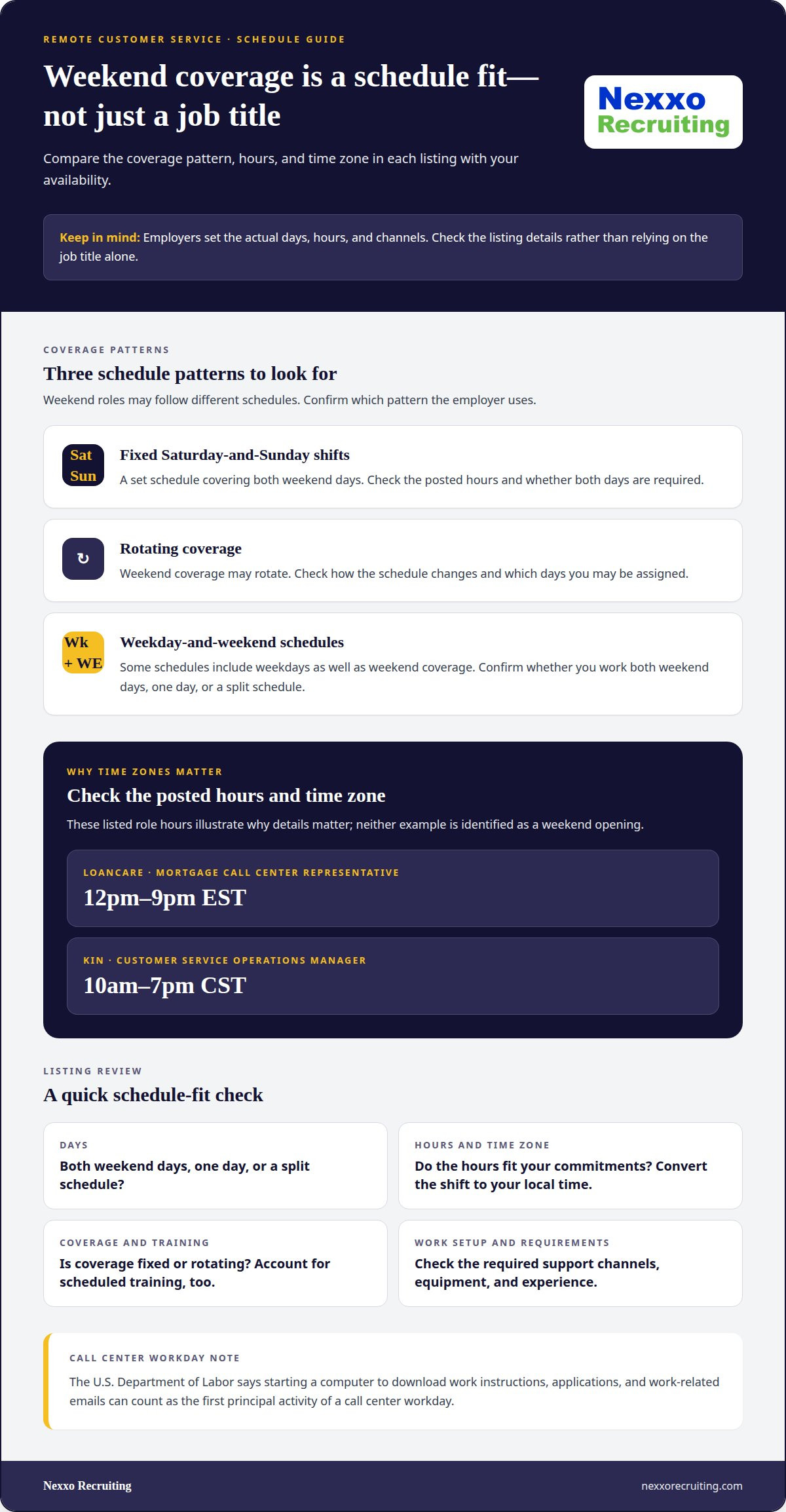
Employers may schedule weekend coverage through fixed Saturday-and-Sunday shifts, rotating coverage, or schedules that include weekdays. Listings should clarify whether you work both weekend days, one day, or a split schedule. Listed roles illustrate why exact hours and time zones matter: LoanCare’s Mortgage Call Center Representative lists 12pm-9pm EST, while Kin’s Customer Service Operations Manager lists 10am – 7pm CST. These examples show listed role hours, not that either role is a weekend opening.
To assess fit, compare the posted hours with your regular commitments and convert the shift to your local time. Check whether both weekend days are required and whether coverage is fixed or rotating. Account for scheduled training, too. The U.S. Department of Labor says starting a computer to download work instructions, applications, and work-related emails can count as the first principal activity of a call center workday.
Skills and Tools for Remote Customer Service
Remote support relies on clear communication, careful listening, and consistent follow-through. On a phone call, you may confirm the customer’s issue, explain the next step, and document the outcome. In email or chat, concise writing helps prevent confusion and keeps replies focused. Patience is useful when customers are frustrated, and sound judgment helps you recognize when a request needs escalation.
Common tools include customer relationship management (CRM) records, help-desk queues, knowledge bases, and phone or chat platforms. CRM records show earlier interactions, while knowledge bases provide process instructions. Support ticket triage means assessing a request and routing it appropriately. Follow the employer’s privacy and verification procedures. In your application, describe an example of accurate documentation, resolving a concern, or learning unfamiliar software. If you have used spreadsheets or scheduling systems, name the task you completed rather than claiming experience with tools you have not used.
FAQs
Can entry-level candidates apply for remote customer support roles?
Yes. Nexxo Recruiting features remote job listings tailored to entry-level job seekers. Review each posting’s requirements and responsibilities to find roles that match your experience.
Are part-time and seasonal employees subject to different tax withholding rules?
No. According to the Internal Revenue Service, part-time and seasonal employees are subject to the same tax withholding rules as other employees.
What should you emphasize in an application?
Give specific examples of customer communication, problem-solving, and accurate recordkeeping. Link each example to a responsibility in the posting.