
A junior title doesn’t lower the bar for remote work: you still need to demonstrate practical web fundamentals, communicate your progress clearly, and handle tasks with limited in-person support. That can make remote junior web developer jobs harder to assess than the title suggests. Listings vary in their focus on front-end work, database skills, degrees, project examples, or professional experience. Use this guide to identify relevant entry-level and graduate titles, distinguish essential skills from preferred qualifications, and show how coursework, personal projects, internships, or other experience demonstrate your readiness. You’ll also learn how to assess day-to-day responsibilities, decide what to strengthen before applying, and focus on roles that match your current skills. These criteria can help you choose which gaps to address first and which opportunities are realistic next steps.
Key Takeaways
- Compare junior, graduate, and adjacent web roles by their day-to-day duties, not title alone.
- Prioritize core web fundamentals, then identify which role-specific skills could strengthen your applications.
- Use projects, coursework, internships, or related experience to show how you approach practical development work.
- Read each listing for required qualifications and remote-work expectations before deciding where to apply.
Entry-level and graduate software jobs
Remote junior web developer jobs include entry-level and graduate roles, but the title alone doesn’t define the work. A junior frontend developer might build page components, fix layout issues, or connect interface elements to existing services. A graduate software developer might handle a range of tasks, follow established code standards, and work with senior developers. Read the responsibilities before deciding whether a role fits your skills.
Entry-level opportunities appear under titles such as junior web developer, associate software developer, graduate developer, and frontend developer. Some employers consider applicants without professional experience; others ask for internships, a degree, or completed projects. Separate required qualifications from preferred ones. For example, if JavaScript is required but a computer science degree is preferred, relevant coursework or a personal project demonstrating JavaScript may support your application.
- Junior frontend developer: Look for tasks involving page structure, responsive layouts, and interface behavior.
- Graduate software developer: Check whether the role offers structured onboarding or expects you to contribute to an existing codebase immediately.
- Web developer intern: Review the schedule and project scope; internship roles may be temporary or tied to a school program.
- Associate developer: Examine the listed duties, since this title can cover web work or broader software responsibilities.
Use practical tools to make your work easier to review. GitHub helps organize code and show project history. Visual Studio Code supports writing and editing project files. Chrome DevTools lets you inspect layouts, test browser behavior, and investigate interface issues. A small portfolio project can show how you use these tools together, such as a multi-page site with fixes documented in GitHub.
For each opportunity, match a core task to a concrete example from your experience. If the role involves responsive interfaces, point to a project that adapts to different screen sizes. If it emphasizes collaboration, describe a group assignment and your contribution. This helps you focus on graduate and entry-level openings where your evidence aligns with the work.
Programming languages and technical skills
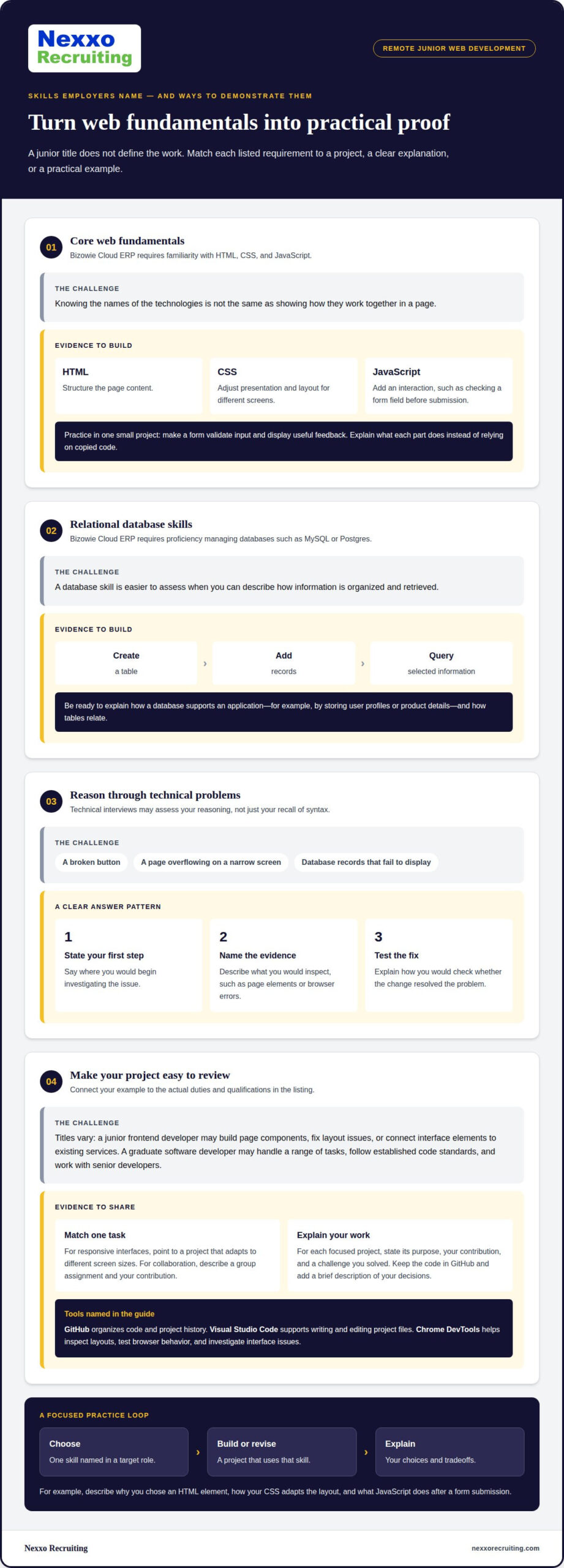
Build your skills around the requirements employers name. Bizowie Cloud ERP requires familiarity with HTML, CSS, and JavaScript web fundamentals. HTML structures page content, CSS controls presentation, and JavaScript adds interactive behavior. Practice combining them in a small project, such as a form that validates input and displays useful feedback. Explain how each part works instead of relying on copied code.
Some junior roles also require relational database skills. Bizowie Cloud ERP requires proficiency managing databases such as MySQL or Postgres. Practice creating a table, adding records, and retrieving selected information with a query. You should be able to explain how a database supports an application, such as storing user profiles or product details. Review the posting before deciding which database topics deserve priority.
- HTML and CSS: Build a clear page structure, then adjust spacing, colors, and layout for different screens.
- JavaScript: Write a small interaction, such as checking a form field before submission.
- MySQL or Postgres: Describe how tables relate and demonstrate a query that returns relevant records.
Technical interviews often assess your reasoning, not just your recall of syntax. Prepare to explain how you would investigate a broken button, a page overflowing on a narrow screen, or database records that fail to display. For each problem, state your first step, identify the evidence you would inspect, and describe how you would test a fix. Chrome DevTools can help you inspect page elements and browser errors. Visual Studio Code supports code editing, while Git tracks changes and lets you review earlier versions.
Use a focused practice routine. Choose one skill named in a target role, build or revise a project that uses it, then rehearse a short explanation of your choices and tradeoffs. For example, explain why you used a particular HTML element, how your CSS adapts the layout, and what JavaScript does after a form submission. This gives you specific evidence for technical discussions and helps reveal gaps before you apply.
Remote junior developer job listings
The current search lists 71 remote junior web developer positions, including 3 new jobs this week. Listings can change quickly, so filter by title, location eligibility, and required skills. “Remote” may still mean applicants must live in a particular state or time zone. Read the location details before tailoring an application. Then compare each role’s daily duties with your experience, not just the job title.
Build a portfolio of a few focused projects related to the work you want. For each one, explain its purpose, your contribution, and a challenge you solved. Store the code in a GitHub repository and add a brief description so reviewers can understand your decisions.
Check whether the employer, role, and application process are consistent across the listing and the company’s official presence. Treat requests to pay for equipment, share sensitive personal details before a legitimate hiring process, or accept a check in exchange for forwarding funds as serious warning signs.
- LinkedIn: Saved searches help track roles by title and remote location requirements.
- Google Alerts: Job-related alerts can surface new public postings matching a phrase you choose.
- Google Sheets: A simple tracker records the employer, role, posting date, requirements, and application status.
Use the same review process for every listing. Note the employer and exact job title, separate required skills from preferred qualifications, and identify the application instructions and any location limits. Record the posting date and prioritize roles whose tasks match your projects. For example, an interface-focused listing is a closer fit if your portfolio includes a working web interface. Tailor your resume and project links to the specific duties, and keep application notes organized for easier follow-up.
Education and experience requirements
A computer science degree can provide structured practice in programming, algorithms, and software development. Some employers require a bachelor’s degree; others accept equivalent experience or prioritize demonstrated skills. Read the qualifications carefully. If a degree is preferred rather than required, highlight relevant coursework, projects, or technical work.
Experience doesn’t have to come from a developer job. A class project, internship, volunteer website, or independently built application can show how you approach practical tasks. Describe your role precisely: explain how you implemented a form, handled a bug, or coordinated code changes with classmates. Don’t present a group project as entirely your own work.
- Degree or coursework: Name relevant computer science classes and the skills you practiced.
- Internship or volunteer work: State the project, your contribution, and the result you delivered.
- Personal project: Explain the problem it addresses and the technical decisions you made.
- Related work: Connect roles such as technical support to troubleshooting, documentation, or customer communication.
Use Google Docs to tailor your resume to each posting, and organize project code in GitHub. Match requirements with evidence: connect a course to a relevant skill or a project to a listed responsibility. Keep descriptions specific. “Built a responsive event page” gives a clearer picture than “worked on websites.” If you have limited experience, lead with completed projects and explain your individual contribution.
Prepare a short explanation for gaps between your background and the listing. If you studied through a boot camp instead of a degree program, name the coursework and describe a project that applied it. If your previous job was outside software, identify transferable tasks without overstating your coding experience. Explore current remote job listings to find roles that align with your skills and experience.
Nexxo Recruiting
Nexxo Recruiting gives you a practical next step: browse remote job listings and focus on roles that match your skills. Listings include opportunities across tech and other entry-level fields, with job details and direct application links to help you assess each opening. Use the role requirements, location terms, and responsibilities to narrow your search for junior web development work. Turn to the listings when you’re ready to move from building skills to reviewing specific opportunities. Nexxo Recruiting helps you find openings to consider; your experience and fit guide where you apply. Contact Nexxo Recruiting if you’d like help finding relevant job listings.
Make Your Next Application Deliberate
Turn preparation into a focused search. Treat remote junior web developer jobs as distinct opportunities, not one uniform role. Track openings whose responsibilities match your skills, then tailor each application to the work described. Keep project examples and application notes organized so you can respond clearly when a suitable position appears. A consistent process directs your effort toward roles that fit your goals.
Nexxo Recruiting’s team applies its recruiting expertise to listing opportunities for entry-level job seekers. Review relevant openings as you prepare your next application. For a direct next step, contact Nexxo Recruiting. Choose a role that fits and move forward with purpose.
Frequently Asked Questions
What remote junior web developer jobs are available in the United States?
Remote junior web developer jobs in the United States include openings focused on website interfaces, feature updates, and application maintenance. Some listings emphasize frontend implementation, while others combine web work with general software development. Review the position’s deliverables to understand the actual scope. For example, a role centered on updating existing pages calls for different evidence than one focused on building new application features.
Which companies hire entry-level remote web developers?
Hiring changes as employers open and close positions, so current listings provide the clearest answer. Triton One has listed a remote Junior Frontend Software Developer role. Bizowie Cloud ERP has also appeared in role requirements for junior web development skills. Treat company names as starting points, not a complete hiring list. Search current openings by title and read each employer’s requirements before applying.
What skills and technologies do remote junior web developer jobs require?
Requirements vary with the work, but employers commonly assess whether you can implement features, investigate defects, and explain technical choices. Prepare to discuss how you would handle an input error or a change that affects existing functionality. Familiarity with testing concepts and clear technical documentation can also help. Use a brief project walkthrough to show how you approach a task from initial requirements through review.
What qualifications or experience are needed for remote junior web developer roles?
Employers set their own qualifications, and some consider practical evidence alongside formal education. A relevant degree, certificate, boot camp, internship, or independent project can demonstrate preparation. Match each qualification to the job’s stated needs. For example, connect a software course to a listed technical requirement, then explain how you applied what you learned. Be accurate about your role and the support you received.
Where can I find legitimate remote junior web developer job listings?
Nexxo Recruiting lists remote entry-level openings, including technology roles, with position details and direct application links. Review the employer, responsibilities, and application route before submitting your materials. A clear listing helps you assess whether the role fits your experience and where to send your application. Record the position and application date to manage follow-up.
What does the interview process for remote junior web developer jobs involve?
The process varies by employer, but it may include an initial conversation, a technical discussion, and a review of your work. Be ready to explain a project, including your decisions, challenges, and individual contribution. Interviewers may also assess how you communicate remotely. Practice describing a task clearly, asking focused questions about requirements, and explaining how you would share an update if you encountered a blocker.