
Remote AI data annotation jobs involve labeling images, audio, video, or documents, reviewing AI-generated responses, and checking information for accuracy. The work is task-focused, and responsibilities vary by project and subject expertise.
You may need to submit an application or complete a skills assessment, then follow detailed instructions and meet accuracy standards. This guide explains common tasks, project expectations, and what qualifications different roles may require.
Key Takeaways
- Identify the core tasks in annotation roles, from reviewing AI responses to labeling data.
- Assess advertised hourly pay by looking at the project type, required expertise, and workload.
- Prepare for applications that may assess your subject knowledge, attention to detail, and ability to follow instructions.
- Use remote job listings to find opportunities that fit your experience and preferred type of work.
AI response review and accuracy checking
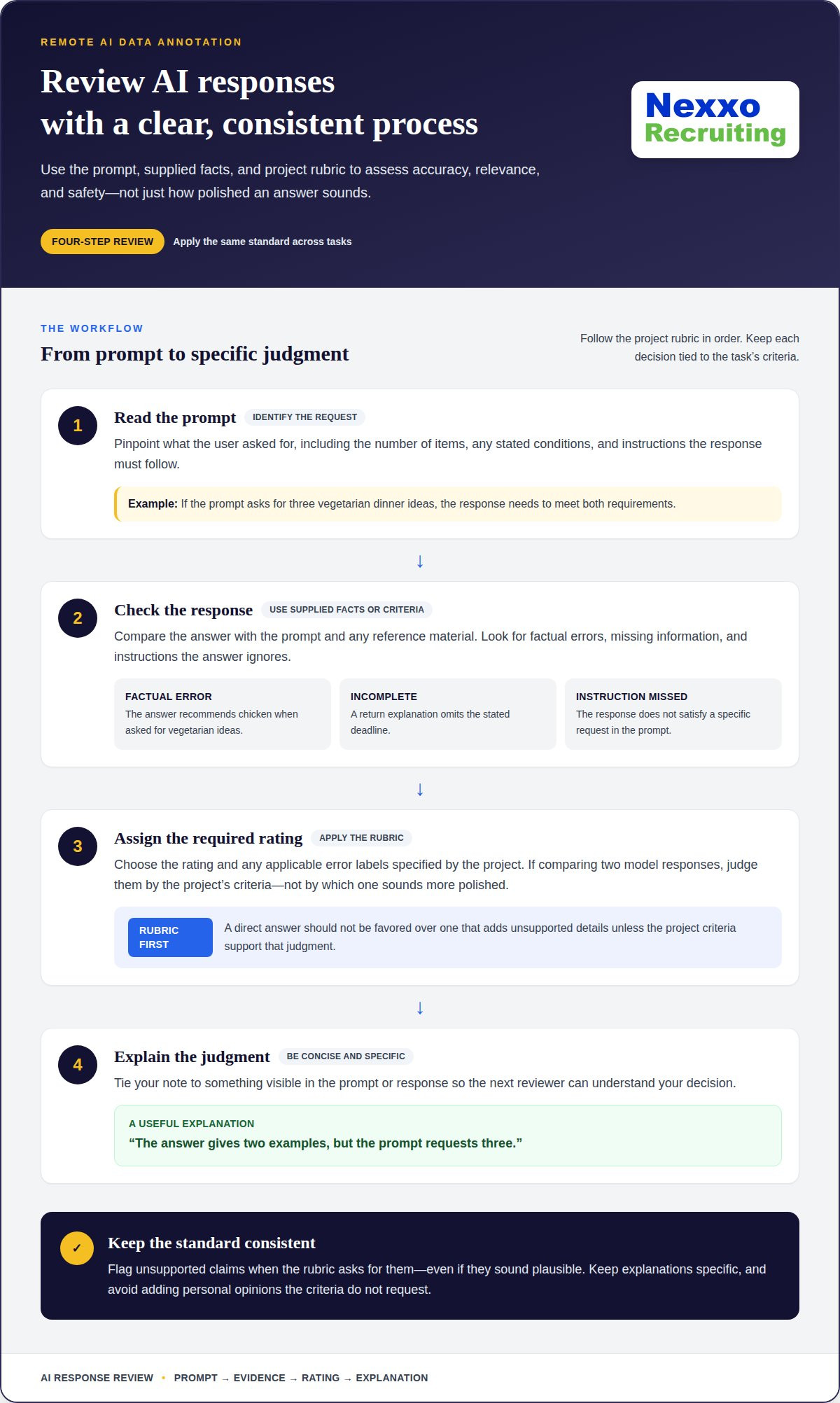
Some remote annotation work involves judging whether an AI-generated answer is accurate, relevant, and safe to use. Compare the response with the prompt and any supplied reference material, then mark errors or explain your rating. For example, if a user asks for three vegetarian dinner ideas, flag a response that recommends chicken.
The work involves more than proofreading. A reviewer may need to distinguish a factual error from an incomplete answer, or identify when a response ignores an instruction. In a product-support example, an answer that describes a return process but omits the stated deadline is incomplete, even if its other details are correct.
Follow the project rubric in order. A typical review may involve these steps:
- Read the prompt and identify its specific request.
- Check the response against the provided facts or criteria.
- Assign the required rating and select any applicable error labels.
- Add a concise explanation tied to the response, such as “The answer gives two examples, but the prompt requests three.”
Accuracy checks may also involve comparing two model responses. If one answers the question directly and the other adds unsupported details, rate them according to the project’s criteria, not which sounds more polished. Clear notes help the next reviewer understand your judgment.
For U.S. remote annotators, tax treatment and employment rules depend on worker classification and applicable location requirements. Before accepting a role, read the posting and agreement for classification, tax paperwork, eligible work locations, and schedule.
Instructions should define what counts as correct, incomplete, or problematic. If the rubric says to flag unsupported claims, mark a response that invents a product feature, even if the feature sounds plausible. Apply the same standard across tasks, keep explanations specific, and avoid personal opinions the criteria do not request.
Project expectations
An AI annotation listing describes the project, not a promise of steady work. Compare the task, qualifications, expected hours, and contract terms before deciding whether the opportunity fits your schedule.
Role requirements help explain why projects differ. A worldwide imagery analyst may need strong visual judgment, while a senior technical documentation annotator needs relevant industry experience. Medical imaging projects call for clinical expertise. Video annotation, PDF review, and language quality assurance each require different skills and review standards.
Flexibility and stability depend on project terms. A short contract may offer schedule flexibility but limited continuity; a role requiring weekly hours sets a clearer workload expectation. Compare the project duration, task volume, and any minimum availability requirement.
Read each posting for these details:
- Project structure: Confirm whether the work is organized by hours, as a fixed project, or around completed tasks.
- Workload: Look for expected hours, required availability, and how assignments are distributed.
- Eligibility: Check location and specialty requirements. A language role or medical annotation project may restrict applicants by expertise or region.
- Contract terms: Note the stated project duration and whether continued assignments are described.
For example, compare a medical image annotation contract and a general video labeling role by more than their headline descriptions. Clinical knowledge, evaluation criteria, and project scope affect the work involved. A project may include specialized duties or limited hours, while another may involve a different task or eligible location.
If a listing specifies at least twenty hours weekly, that requirement helps define the expected commitment, but does not establish how long the project will continue. Compare the qualifications and workload, then decide whether the terms fit your schedule.
Application and qualification process
Most applications begin with a role-specific form and a project description. Read the eligibility criteria first. A listing may focus on language, coding, healthcare knowledge, or general reasoning, so tailor your application to its stated requirements.
Some roles require an assessment. A language project might ask you to interpret a passage, while a coding project could test code review. Follow the instructions closely, explain your judgments clearly, and avoid adding details the task does not request. These assessments test subject knowledge and consistency.
Before applying, prepare a concise work history that connects your experience to the project. Customer support experience can help with evaluating response tone; research experience can support source checking. Describe relevant tasks and tools accurately, and don’t claim specialized expertise you can’t demonstrate in an assessment.
Equipment and software requirements vary by project. Start with a reliable computer, stable internet connection, and a workspace with few distractions. The posting should identify any required platform or additional tools. Check that your device can open the task interface and handle the files used in examples.
Remote AI annotation jobs can be legitimate, but a professional-looking title alone doesn’t prove an offer is genuine. Treat requests for financial account credentials or sensitive identity details before a clear hiring process as warning signs.
Use this sequence to assess a posting and prepare:
- Confirm the role’s location, subject area, and stated qualifications.
- Review the employer identity and application process for consistent details.
- Complete any sample task independently and follow its rubric.
- Read the contract terms for worker classification and schedule before accepting.
Keep copies of the posting and written terms. If a recruiter changes the role or asks you to move communication to an unrelated channel, pause before sharing information. A clear application process explains the task, evaluation steps, and next-stage requirements without pressuring you to act immediately.
Data labeling and fact-checking
Data labeling assigns categories or descriptions to raw material. In an image task, you might mark where a vehicle appears and label it “car” or “truck.” For audio, you could identify spoken words, speakers, or background sounds. The project’s label definitions determine how to handle unclear examples.
Fact-checking adds a separate judgment: whether a statement matches reliable reference material. For a document task, compare a date, name, or claim with the supplied source. If a PDF says a meeting occurred on Tuesday but the reference says Wednesday, record the discrepancy rather than silently correcting it.
Some projects are specific to a subject or format. A worldwide music audio annotation contract suits professionals with a trained ear. A Korean document annotation quality-assurance role reviewing PDFs requires attention to text accuracy and consistency. One such posting specifies at least twenty hours per week, so consider the commitment as well as the task itself.
Use a repeatable review process:
- Read the label definitions and examples before assigning categories.
- Apply the same rule to similar items, including borderline cases.
- Separate what the source states from what you infer.
- Flag missing, contradictory, or unreadable information using the project’s instructions.
For example, if a music clip contains speech over an instrumental track, don’t label the entire recording as music without checking the available categories. If the task distinguishes speech from background audio, mark each element according to its instructions. Consistent labels help make datasets usable for later evaluation and training.
Accuracy depends on careful reading, not guesswork. Keep notes on recurring edge cases, but follow the project’s approved guidance when deciding how to label them. If you’re ready to compare remote roles by subject and task type, explore relevant remote opportunities.
Nexxo Recruiting
Nexxo Recruiting gives you a place to explore remote job listings as you assess whether annotation work fits your skills and schedule. Review each posting for its actual duties, subject requirements, work location, and contract terms. Those details help you distinguish response review, labeling, and specialized projects before applying.
Use the listings when you’re ready to move from researching the work to considering specific openings. Compare the stated qualifications with your experience, then follow the application instructions in the posting. A listing is a starting point for evaluating an opportunity, not a promise of placement or continued assignments.
If you’re ready to explore remote roles, contact Nexxo Recruiting.
Choose a Next Step That Fits Your Goals
Remote AI data annotation jobs let you apply skills in writing, research, languages, or specialist fields. Treat your first application as a chance to assess fit: consider which tasks hold your attention, where you can demonstrate accuracy, and what project structure suits your working style. That clarity can guide your next opportunity, even if a particular role isn’t the right match.
Nexxo Recruiting’s expertise in recruiting helps job seekers find openings to consider as they decide where to apply. Read each posting closely and base your next move on its requirements and your experience. A deliberate application is better than sending the same materials to every role.
Contact Nexxo Recruiting about remote work and take the next step toward a role that fits your strengths.
Frequently Asked Questions
What kind of position is this?
These roles focus on preparing or evaluating data used in AI systems. Depending on the opening, you may work as an annotator, response evaluator, language reviewer, or subject-matter specialist. Some positions are project contracts rather than ongoing employment. Before deciding whether a role fits your needs, read the listing for its work arrangement, expected schedule, qualifications, and how tasks are assigned.
What kind of projects are available?
Projects can cover text, images, audio, video, or documents. Examples include reviewing Korean PDF documents, annotating medical images, and labeling music audio. Some tasks require a particular language or professional background, while others focus on general review. The project’s content and instructions shape the work, so a music annotation opening may suit a trained ear better than a document review role.
What kind of work will I do?
You’ll follow task instructions to classify, review, or assess information for an AI project. A task might ask you to mark an image element, judge whether a response follows a prompt, or identify a mismatch between a document and its reference. Some assignments require short written explanations. Expect to pay close attention to task criteria and treat similar examples consistently.
Who is this for?
This work can suit people who read carefully, follow detailed instructions, and make consistent judgments. The best fit depends on the project: language-focused assignments require relevant language skills, while medical or legal data work may call for specialized knowledge. General review tasks may emphasize reasoning and clear written explanations. Choose openings that match skills you can demonstrate, rather than applying just because a role is remote.
What remote AI data annotation jobs are available in the United States?
U.S.-based opportunities can include image annotation, document review, video labeling, and AI response evaluation. Some openings target specialized fields, such as medical image annotation, while others focus on general data labeling. Listings may describe contract work, project-based assignments, or a specific expected workload. Check each role’s location eligibility and qualifications, since “remote” does not automatically mean every U.S. applicant can participate.
Which companies hire remote data annotators, and where do they post openings?
Employers and organizations running AI projects recruit annotators directly or through hiring platforms. Openings may appear on employer career pages and remote job boards. Nexxo Recruiting lists remote opportunities in areas such as data entry and tech, with job details and direct application links. Review each posting’s project type, eligibility, and application steps to decide whether to apply.