
Entry-level remote customer service and sales roles include customer care coordinator, booking agent, and sales representative positions. Job titles can overlap, and postings vary in requirements, work arrangements, and compensation, so it can be hard to tell which openings fit your background.
This guide covers common roles, employer requirements, remote-work arrangements, and how to compare advertised pay, helping you focus your applications on suitable opportunities.
Key Takeaways
- Compare customer service and sales roles by their daily responsibilities, not job titles alone.
- Identify the experience, education, and skills each posting asks for before you apply.
- Check whether a role is remote or fully remote and what that means for your work setup.
- Use Nexxo Recruiting job listings to explore remote openings suited to entry-level applicants.
Customer service and sales roles
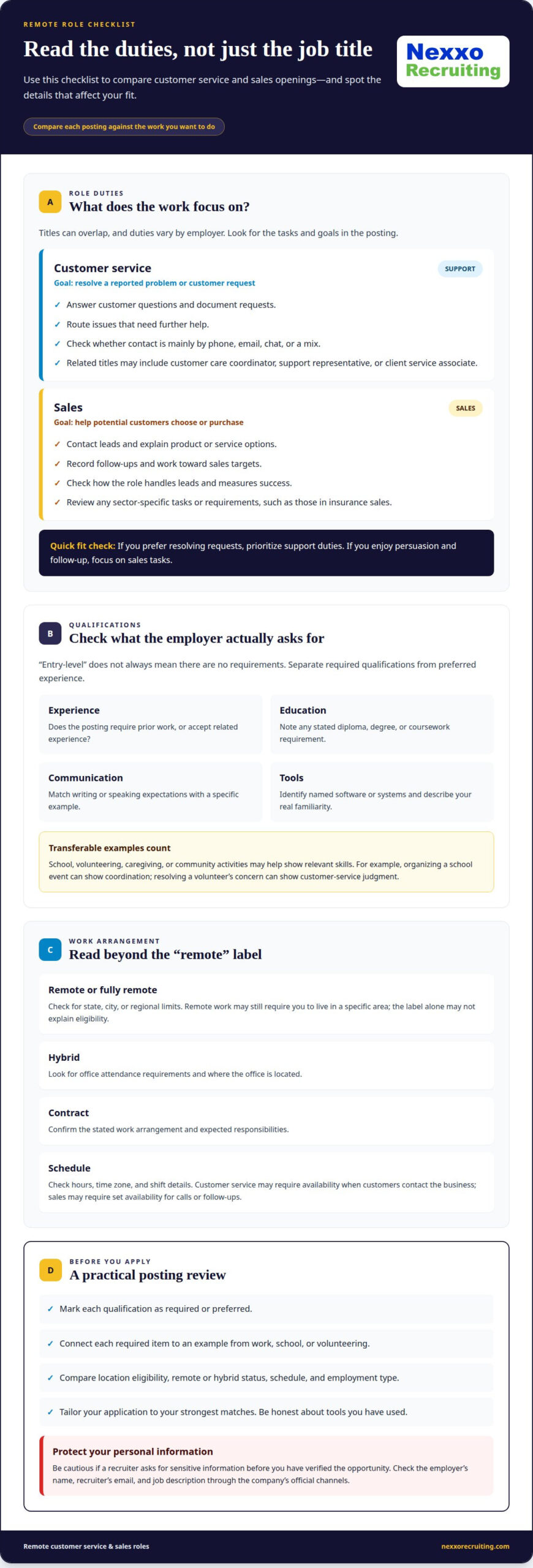
Customer service openings may be titled customer care coordinator, support representative, or client service associate. You might answer customer questions, document requests, and route unresolved issues. Duties vary by employer, so check whether the role centers on phone calls, email, chat, or a mix of channels.
Sales roles focus on helping potential customers choose or purchase a product or service. An entry-level sales representative may contact leads, explain options, record follow-ups, and work toward sales targets. Some listings focus on a sector, such as insurance, while others describe sales more broadly. Check how the role handles leads and measures success.
- Customer care coordinator: Look for duties involving customer questions, account records, and issue routing.
- Customer support representative: Check whether the listing names phone, email, or chat as the main contact channel.
- Sales representative: Look for lead follow-up, product explanations, and sales targets in the responsibilities.
- Insurance sales agent: Review the listed sales tasks and any role-specific requirements before applying.
To spot a remote job scam, be cautious if a recruiter asks for sensitive information before you have verified the opportunity. Before sharing personal details, verify the employer’s name, the recruiter’s email, and the job description through the company’s official channels.
Customer service and sales both involve communication, but their goals differ. A support representative works to resolve a reported problem, while a sales representative follows up with a potential buyer. If you prefer resolving requests to pursuing sales targets, prioritize support duties. If you enjoy persuasion and follow-up, focus on sales tasks.
Use each posting as an application checklist. Match its duties to examples from work, school, volunteering, or a personal project. You might describe how you handled a customer concern or organized follow-up messages. Specific examples help employers assess your skills, even if your previous job title differs.
Experience and education requirements
“Entry-level” describes the role’s level, not a promise that it has no requirements. A customer support posting may prioritize clear writing, steady communication, and accurate recordkeeping. A sales listing may emphasize listening, follow-up, and comfort discussing products. Read the qualifications carefully, distinguishing requirements from preferred experience before deciding whether to apply.
What are the best entry-level remote jobs with no experience? Customer support and sales can be practical starting points when their listed requirements match your skills. Look for postings that accept transferable examples from school, volunteering, caregiving, or community activities.
Organizing a school event, for example, can demonstrate coordination. Helping resolve a volunteer’s concern can show customer-service judgment, while a class presentation can demonstrate clear communication. Describe what you did and the result rather than simply claiming a skill. Keep each example relevant to a duty in the posting.
- Experience: Check whether the listing requires prior work or accepts related experience.
- Education: Note any stated diploma, degree, or coursework requirement.
- Communication: Match writing or speaking expectations with specific examples.
- Tools: Identify any named software or systems, then describe your real familiarity.
Use a simple review before applying. First, mark each qualification as required or preferred. Next, connect every required item to an example from work, school, or volunteering. Finally, tailor your application to your strongest matches. If you haven’t used a system named in the posting, don’t claim expertise. Instead, highlight a related tool or task you know.
Education expectations vary by employer and role. A customer care position may focus on communication and accurate notes, while a sales role may value customer interaction and consistent follow-up. Use the posting, rather than assumptions based on the title, as your guide. If you’re new to paid work, show how specific responsibilities prepared you for the listed tasks.
Job types and work arrangements
Remote customer service and sales roles differ in location rules, schedules, and employment type. A listing marked “remote” may still name a state or city, as with remote customer care openings in Dallas and scheduling roles in Texas. “Fully remote” also appears in postings, including a Texas booking agent role. Read the location details, not just the title.
Remote does not always mean you can work from anywhere. Employers may limit hiring to particular states or regions. A Texas listing, for example, may require applicants to live in Texas even though the work is online. Check location requirements before tailoring your application to avoid spending time on a role outside your eligible area.
- Remote: Check the posting for state, city, or other location limits.
- Fully remote: Read the same location details; the label alone may not explain them.
- Hybrid: Look for office attendance requirements and where the office is located.
- Contract: Confirm the listing’s stated work arrangement and expected responsibilities.
Schedule matters in customer-facing work. A customer service representative may need to respond during the hours customers contact the business. A sales role may require set availability for calls or follow-ups. Check the schedule, time zone, and shift details. If these are unclear, make them a priority during the hiring process.
Compare roles against your practical needs. If you need fully remote work, prioritize postings that use that label and specify a location you’re eligible to work from. If you can commute, a hybrid opening may also fit. Then consider whether the schedule and work arrangement suit your routine. For example, someone with caregiving duties may need predictable hours, while another applicant may prefer a set shift.
Before applying, make a short checklist for each posting: location eligibility, remote or hybrid status, schedule, and employment type. Compare these details across customer support and sales listings. This keeps your search focused on suitable roles instead of relying on “remote” in the headline alone.
Salary ranges
Listed pay varies across remote coordinator and booking roles. Treat each figure as specific to that posting, not every job with the same title.
Other advertised ranges show why job titles need close comparison. A Houston travel itinerary coordinator listing gives the same range.
Compare duties as well as pay. Both titles relate to hospitality, but the advertised ranges differ. Review responsibilities, location, and employment terms before comparing them.
Check whether a posting describes annual salary, hourly pay, commission, or contract compensation. These terms affect how to interpret the advertised amount. The research examples include annual salary ranges, while trading analyst contract listings use monthly pay. Keep the pay period attached to each figure when reviewing or comparing postings.
Use a consistent comparison process: note the job title, location, remote status, pay period, and listed compensation. Then compare roles with similar duties. Booking coordinator postings, for example, may involve different responsibilities across employers. A higher advertised range alone doesn’t show which position best fits your skills or work preferences.
Nexxo Recruiting
Nexxo Recruiting helps early-career job seekers explore entry-level remote openings through tailored job listings. Use the listings to compare roles after clarifying your preferred work, qualifications, and location needs.
Listings cover customer support, data entry, tech, digital marketing, and virtual assistant work. Each post provides job details and a direct application link. Review an opening’s duties and requirements, then decide whether it fits your experience and work preferences.
Use listing details to narrow your search, not as a promise of employment. Tailor each application to the employer’s stated requirements and work arrangement. Browse Nexxo Recruiting’s job listings to find openings that suit your priorities.
Take the next step with a focused search
Turn your priorities into a clear search plan. Decide which responsibilities you want to gain experience in, what work arrangement fits your routine, and which qualifications you can demonstrate now. Use those choices to assess each opening consistently. A focused approach can make the search for entry-level remote jobs more manageable, especially when similar titles describe different work.
Nexxo Recruiting’s team brings expertise in connecting early-career job seekers with relevant job listings. Use them as a starting point, then review each employer’s details and application requirements carefully. Your experience may come from school, volunteering, or other responsibilities, so present relevant examples clearly and honestly.
Take one practical step today: Explore remote job listings and identify an opening that matches your goals. A clear, considered application is a strong way to move forward.
Frequently Asked Questions
What entry-level remote jobs are hiring in the United States right now?
Openings change as employers publish and close postings. Current listing categories include data entry, technology, digital marketing, virtual assistance, and customer support. Filter by your location eligibility and preferred work arrangement, then review each posting’s application status and employer details. This helps you focus on active roles rather than relying on a general job title.
What is the average salary for entry-level remote jobs by role?
There is no meaningful average across all entry-level roles because pay depends on the position and compensation structure. Compare openings with similar duties, locations, and pay periods. Separate annual salaries from monthly contract pay, and check whether sales compensation includes commission. For a fair comparison, use the advertised compensation and terms in each posting rather than combining unlike roles into one figure.
Which companies hire entry-level remote workers?
Employers’ active openings change, so use the company named in each posting rather than assuming a particular employer is hiring. Review the employer’s responsibilities, requirements, and application destination before submitting materials. Nexxo Recruiting listings include direct application links to help you identify the employer and follow the instructions for that vacancy.
What skills and qualifications do entry-level remote jobs require?
Requirements vary by role, but employers may seek clear written communication, organization, dependable follow-through, and comfort using workplace software. A virtual assistant applicant, for example, can describe tracking appointments or organizing shared files. A digital marketing applicant can point to a class project or volunteer task. Match each example to a skill named in the posting.
Are entry-level remote jobs available full-time, part-time, or contract?
Remote vacancies may be full-time, part-time, or contract, as specified in each posting. Contract openings are one option; the research includes entry-level trading analyst contract listings. Before applying, check the employment type, expected schedule, and any stated duration. These details help you decide whether the role fits your availability and work plans.